ICHRA Affordability Jumps to 10.22% for 2027
The IRS set the 2027 ICHRA affordability percentage at 10.22%, the highest on record. See the math and how to reset your contribution before renewal.
The short version
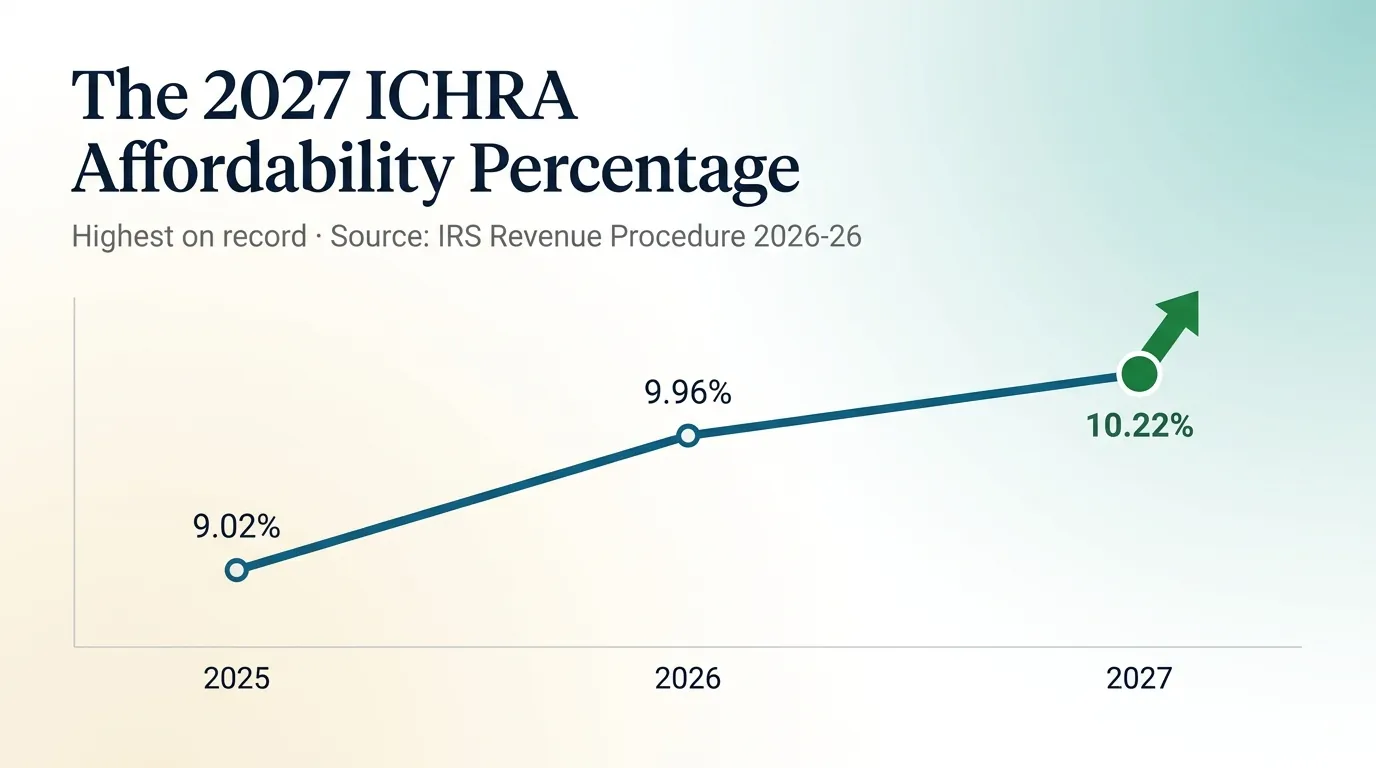
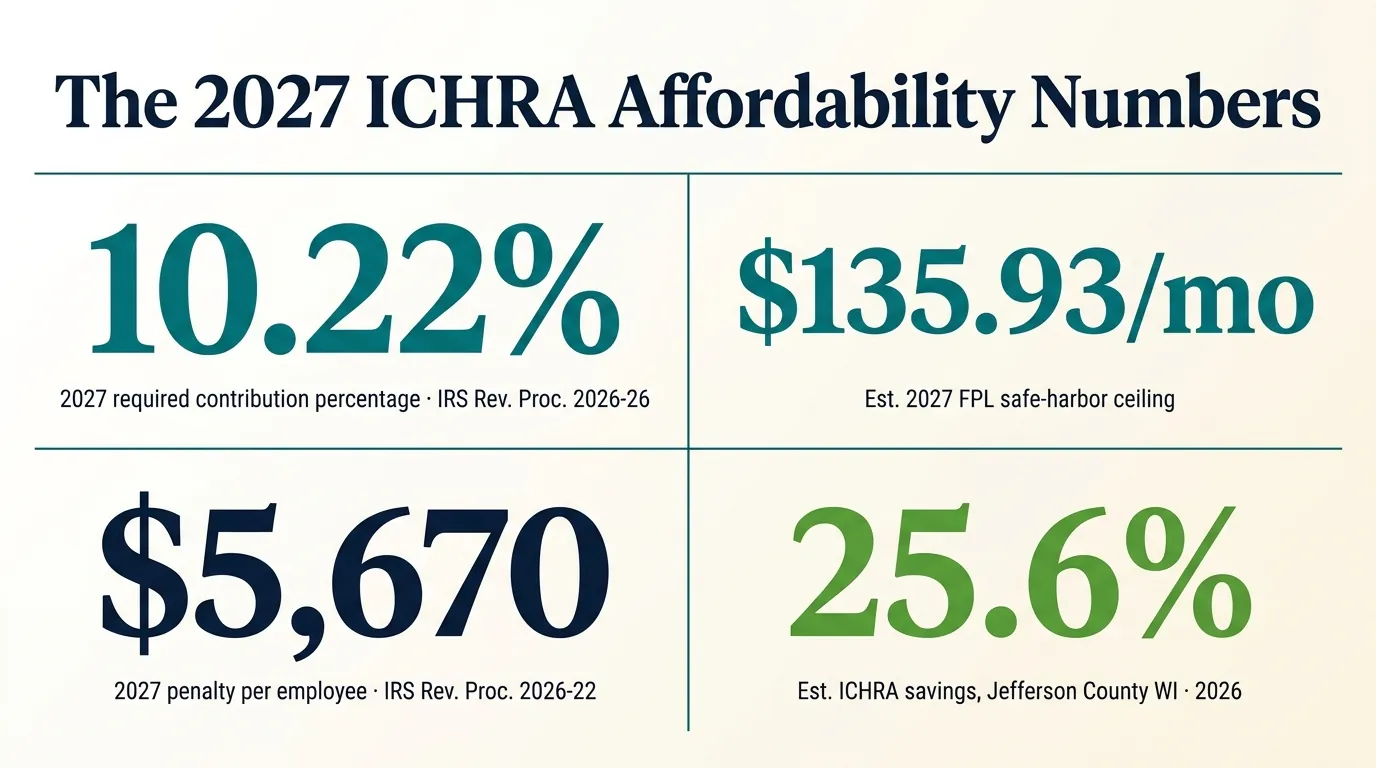
- For plan years beginning in 2027, the IRS set the ACA and ICHRA required contribution percentage at 10.22% of household income, per Revenue Procedure 2026-26, published July 27, 2026. That is up from 9.96% for 2026 and is the highest this figure has ever been.
- A higher percentage raises the ceiling on what an employee can be asked to pay before coverage counts as "unaffordable," which is a small win for employers on paper and a real cost shift for employees.
- The federal poverty line safe-harbor ceiling, one shortcut employers use to prove affordability, rises to an estimated $135.93 a month per employee for 2027, up from about $129.90 for 2026, a gain of roughly $6.03 a month.
- That gain does not automatically cover a premium increase. If your county's benchmark premium rose by more than about $6.03 a month, a flat 2026 contribution can fall out of compliance for 2027 even though nothing about the contribution itself changed.
- Whether an ICHRA still beats small group where your employees live is a separate, county-level question. Wisconsin has 5 qualifying counties in our dataset; Colorado has 14. Check yours before assuming either answer.
What actually changed for 2027
The Internal Revenue Service set the required contribution percentage, the number that decides whether an employer's offer of health coverage counts as "affordable" under the Affordable Care Act, at 10.22% of household income for plan years beginning in calendar year 2027. The figure comes from Revenue Procedure 2026-26, published in Internal Revenue Bulletin 2026-31 on July 27, 2026. It is up from 9.96% for 2026, itself an increase from 9.02% for 2025, and it is the highest the required contribution percentage has been since the rule was created.
If you offer, or are considering, an ICHRA (Individual Coverage HRA), the IRS-defined arrangement where an employer sets a fixed monthly reimbursement and each employee buys their own individual health plan with it tax-free, this number is not background trivia. It is the test your contribution amount has to clear for that offer to count as affordable for each employee, and it resets every single year whether or not your business changed anything else about its benefits. This article walks through where the 10.22% figure comes from, what it actually does to your numbers, a full worked example using real county data, and the order to work through resetting your own contribution before your 2027 plan year begins.
What moved
The required contribution percentage rose from 9.96% (2026) to 10.22% (2027), per IRS Revenue Procedure 2026-26.
What it means
Employees can be asked to pay more, in dollar terms, before an offer is deemed "unaffordable." The ceiling moved up, not down.
What still has to happen
You have to re-run the math with this year's real percentage and this year's real county premium. Neither one carries over from last year on its own.
Why last year's number does not carry over
A lot of employers set an ICHRA contribution once, during their first open enrollment, and then leave it alone unless something forces a change. That habit works fine for a group plan renewal, where a broker hands you a new number every year whether you ask for it or not. It works badly for an ICHRA, because nobody hands you the new affordability math automatically. The IRS updates the required contribution percentage every year, HHS updates the federal poverty guideline every year, and your county's individual-market benchmark premium moves every year too, usually upward. A contribution that cleared the bar for 2026 is not guaranteed to clear it for 2027, and the business that finds out the hard way is usually the one that assumed silence meant nothing had changed.
Nationally, insurers have already filed a median proposed premium increase of 14% for small-group ACA-compliant plans for 2027, across roughly 300 insurers in all 50 states and Washington, D.C., according to the Peterson-KFF Health System Tracker's analysis published August 6, 2026. That figure is for small-group plans, not the individual-market plans an ICHRA funds, but it is a useful signal: premiums are not standing still anywhere in the market this year, and neither is the federal test that decides whether your contribution keeps up with them.
What "affordable" means under the ACA
"Affordable," here, is not a plain-English judgment call. It is a specific federal test, defined under section 36B of the Internal Revenue Code, that compares what an employee would still have to pay, out of pocket, for the lowest-cost plan that meets minimum-value standards against a share of that employee's household income. Clear the test, and the offer is deemed affordable for that employee. Fail it, and two separate things can happen: an Applicable Large Employer can owe a per-employee federal penalty, and the employee, if income-eligible, can decline the offer and claim a premium tax credit on the ACA marketplace instead.
Because checking every employee's actual household income is impractical for most employers, the IRS allows three simplified stand-ins, called safe harbors: the employee's W-2 wages, the employee's rate of pay, or the federal poverty line. Each one lets an employer run the test using information they already have, or a single published number, instead of anyone's tax return. The federal poverty line safe harbor, covered in detail below, is the simplest of the three and the one most first-time ICHRA employers reach for.
9.96% to 10.22%: where the number comes from
The required contribution percentage is not set by guesswork or by political preference in a given year; it is indexed using a methodology tied to projected premium growth and income growth, described in Revenue Procedure 2014-37 and updated guidance from HHS. Per Revenue Procedure 2026-26, the 2027 adjustment is the first to fully reflect a new premium-growth measure HHS introduced for the 2026 benefit year and beyond, one that folds increases in individual-market premiums into the calculation alongside employer-sponsored insurance premiums, under the HHS Marketplace Integrity and Affordability rule (90 Fed. Reg. 27074, June 25, 2025). Before that change, the formula leaned only on employer-sponsored insurance cost growth. Widening the measure to include a faster-moving part of the market pushed the resulting percentage higher.
The same revenue procedure also updates the separate table used to calculate an individual's premium tax credit, the Applicable Percentage Table under section 36B(b)(3)(A)(i). For 2027, every income band in that table tops out at 10.22% as well, meaning even households near 400% of the federal poverty line, the upper edge of subsidy eligibility, can be asked to pay up to that same share of income for the benchmark plan before a subsidy fills the rest of the gap. The two tables share the same ceiling by design.
| Plan year | Required contribution percentage | Source |
|---|---|---|
| 2025 | 9.02% | IRS Rev. Proc. 2024-35 |
| 2026 | 9.96% | IRS Rev. Proc. 2025-25 |
| 2027 | 10.22% | IRS Rev. Proc. 2026-26 |
Source: IRS Revenue Procedures 2024-35, 2025-25, and 2026-26. The 2025 and 2026 figures are included for context and were independently confirmed on IRS.gov and cited in this site's prior coverage; the 2027 figure was fetched directly from IRS.gov on the day this article was written.
The FPL safe harbor for 2027
The federal poverty line safe harbor uses a single number: the 100% federal poverty line for a household of one, regardless of an employee's actual family size, multiplied by the required contribution percentage for that plan year. HHS updates the poverty guideline every January; the IRS rule allows employers to use a poverty guideline in effect within six months of the start of the plan year, which for a calendar-year plan beginning January 1, 2027 means the guideline HHS published in January 2026 is the one in play.
For 2026, the 100% federal poverty line for one person in the 48 contiguous states and D.C. was $15,960, per the HHS notice published in the Federal Register on January 15, 2026 (91 FR 1797, effective January 13, 2026). Multiplying that figure by the 2027 required contribution percentage, 10.22%, and dividing by twelve months produces an estimated monthly ceiling of about $135.93. That is a calculation, not a single number the IRS publishes directly, so the arithmetic is shown here rather than asked to be taken on faith.
The 2027 FPL safe-harbor calculation
$15,960 (2026 FPL, household of one) × 10.22% (2027 required contribution percentage) ÷ 12 months = ~$135.93 a month. An employee's remaining cost for the lowest-cost individual plan, after the employer's contribution, has to fall at or below this figure for the offer to count as automatically affordable under the FPL safe harbor.
For comparison, the same calculation for 2026 used the 2025 poverty guideline, $15,650 for one person, and the 2026 required contribution percentage, 9.96%, producing an estimated ceiling of about $129.90 a month. The 2027 ceiling is roughly $6.03 a month higher, a gain of a little under five percent. That is the entire effect of the percentage increase, on its own, before anything about actual premiums enters the picture.
| Plan year | FPL used | Required contribution % | Est. monthly ceiling |
|---|---|---|---|
| 2026 | $15,650 | 9.96% | $129.90 |
| 2027 | $15,960 | 10.22% | $135.93 |
Sources: IRS Revenue Procedures 2025-25 and 2026-26 (percentages); HHS/Federal Register poverty guideline notices dated January 17, 2025 and January 15, 2026 (FPL figures). Ceiling figures are calculated, not independently published as single dollar amounts; confirm the current figure with a benefits attorney or administrator before relying on it for a compliance decision.
A higher percentage helps employers, not employees
It is worth being direct about which side of this equation benefits, because the framing "the affordability bar went up" sounds neutral and is not. A higher required contribution percentage raises the ceiling on how much an employee can be asked to pay before an offer counts as unaffordable. That is a small structural win for an employer: the same dollar contribution has more room to clear the test than it did the year before, all else equal. It is not a win for the employee on the other side of that contribution, whose maximum required out-of-pocket cost, the threshold before subsidy eligibility opens up, moved higher too.
None of this means an employer should treat a flat contribution as fine forever. The ceiling moving up is real, but it is a small, predictable amount, about five percent this year. County premiums do not move in five-percent increments in any predictable direction; they move based on what carriers actually filed for that market. When premium growth in your specific county outpaces the ceiling's growth, and that is common in a year when insurers nationally filed double-digit increases, the net effect on your contribution requirement is still upward, regardless of what the percentage itself did.
Worked example: a 22-person Jefferson County, WI employer
Numbers land differently attached to a real county. Jefferson County, Wisconsin, home to about 85,932 people in our dataset, shows a 2026 individual-market benchmark of $315 a month against a small-group benchmark of $423 a month, an estimated 25.6% spread, or $1,301 a year per employee. It is one of 5 Wisconsin counties that currently qualify in our data, covering an estimated 285 thousand people.
Jefferson County, Wisconsin: 2026 benchmark premiums
Individual-market vs. small-group benchmark, monthly, per employee
Source: src/data/qualified_counties.json, 2026 plan year (Ideon rate data,
cross-verified against CMS public-use marketplace files). Estimates, not quotes.
Say a 22-employee company in Jefferson County set its ICHRA contribution at $195 a month per employee for 2026, against that county's $315 individual-market benchmark. The employee's remaining cost is $119.83 a month, comfortably under the 2026 FPL safe-harbor ceiling of $129.90, with about $10.07 of room to spare. That offer is affordable.
Roll into 2027 and change nothing: the same $195 contribution against the same, unchanged $315 premium leaves the same $119.83 residual, now measured against the higher 2027 ceiling of $135.93. The offer is even more comfortably affordable, with about $16.10 of room. This is the scenario from the section above: the percentage increase alone, with a flat premium, only helps.
Now add a realistic premium increase
Real county premiums do not stay flat. As an illustrative scenario only, not a sourced projection for Jefferson County specifically, suppose the county's individual-market benchmark rises 8% for 2027, to about $340 a month. The same $195 contribution now leaves a residual of $145.02, which exceeds the 2027 ceiling of $135.93. The offer has quietly become unaffordable, without the employer changing the contribution at all.
Restoring compliance in that hypothetical means raising the contribution to at least $204 a month, an increase of about $9.09 per employee, or roughly $2,400 a year across a 22-person group. Notice that the needed increase, about 4.7% in dollar terms, is smaller than the illustrative 8% premium hike itself, because the higher 2027 ceiling absorbed part of the increase automatically. That is the honest version of "a higher percentage helps employers": it softens a premium increase, it does not cancel one out.
What it costs to get this wrong
Two different costs sit on the other side of an unresolved gap like the one above, and they land on different people. For an employee, an offer that has quietly become unaffordable means losing access to a premium tax credit if they stick with the ICHRA, or facing a higher out-of-pocket cost than the employer's contribution was originally sized to leave them with. For an Applicable Large Employer, a business that averaged 50 or more full-time and full-time-equivalent employees in the prior calendar year, per our guide to the 50-employee mandate, an unaffordable offer that a full-time employee declines in favor of a marketplace subsidy triggers the section 4980H(b) penalty: $5,670 per affected employee for plan years beginning in 2027, under IRS Revenue Procedure 2026-22.
Illustrative math: 5 affected employees, left unfixed
5 affected full-time employees × $5,670 per employee (2027) = $28,350 a year, for an Applicable Large Employer that does not catch the gap before those employees claim a premium tax credit. This is an illustrative calculation using the 2027 penalty figure and a round employee count, not a projection for any specific business.
Smaller employers, those under the 50-employee ALE threshold, do not face a 4980H penalty at all, since the mandate does not apply to them. The cost for a smaller business is different but still real: employees left with an offer that is not genuinely affordable, and the loss of the specific benefit an ICHRA is supposed to deliver, a predictable, adequate contribution toward real coverage. Both employer sizes have the same fix, worked through below.
Why this is not just a Wisconsin question
The federal side of this math, the 10.22% percentage and the FPL safe-harbor ceiling, is identical no matter where your employees live. What differs by state, and by county within a state, is how fast the actual premium half of the equation is moving, which is exactly the variable that decides whether a flat contribution survives the reset. Colorado is a useful second data point precisely because its 2027 numbers are already public and moving in a specific, sourced direction.
Colorado's Division of Insurance announced on July 22, 2026 that preliminary 2027 individual- market rate filings point to an average increase of about 11%, a figure the state describes as "less than the national increase" and attributes partly to Congress's failure to extend enhanced premium tax credits, which the department says destabilized the individual market for the 2026 plan year. That is a statewide average of requested, not yet approved, rates, not a county-level or ICHRA-specific figure, and it will not match every Colorado county's actual move. It does confirm the general pattern this article is built around: county and state premiums are already shifting for 2027, in documented, sourced ways, well before most employers reset their ICHRA math.
Mesa County, Colorado, home to Grand Junction and about 156,131 people in our dataset, shows a 2026 individual-market benchmark of $321 a month against a small-group benchmark of $439 a month, an estimated 26.9% spread, or $1,417 a year per employee. It is the most populous of 14 qualifying Colorado counties in our data, together covering an estimated 440 thousand people.
| County | Population | Individual benchmark | Small-group benchmark | Est. savings |
|---|---|---|---|---|
| Mesa County | 156,131 | $321/mo | $439/mo | 26.9% |
| La Plata County | 55,983 | $419/mo | $557/mo | 24.8% |
| Eagle County | 55,650 | $419/mo | $557/mo | 24.8% |
| Delta County | 31,173 | $360/mo | $557/mo | 35.4% |
| Summit County | 30,955 | $419/mo | $557/mo | 24.8% |
| Montezuma County | 26,070 | $419/mo | $557/mo | 24.8% |
Source: src/data/qualified_counties.json, 2026 plan year (Ideon rate data,
cross-verified against CMS public-use marketplace files). Estimates, not quotes. Individual
results vary by age, plan selection, and carrier participation.
How to reset your number before renewal
None of the math above is complicated once it is laid out in order. It is easy to skip a step when a renewal deadline is close, which is exactly when the skipped step tends to matter most.
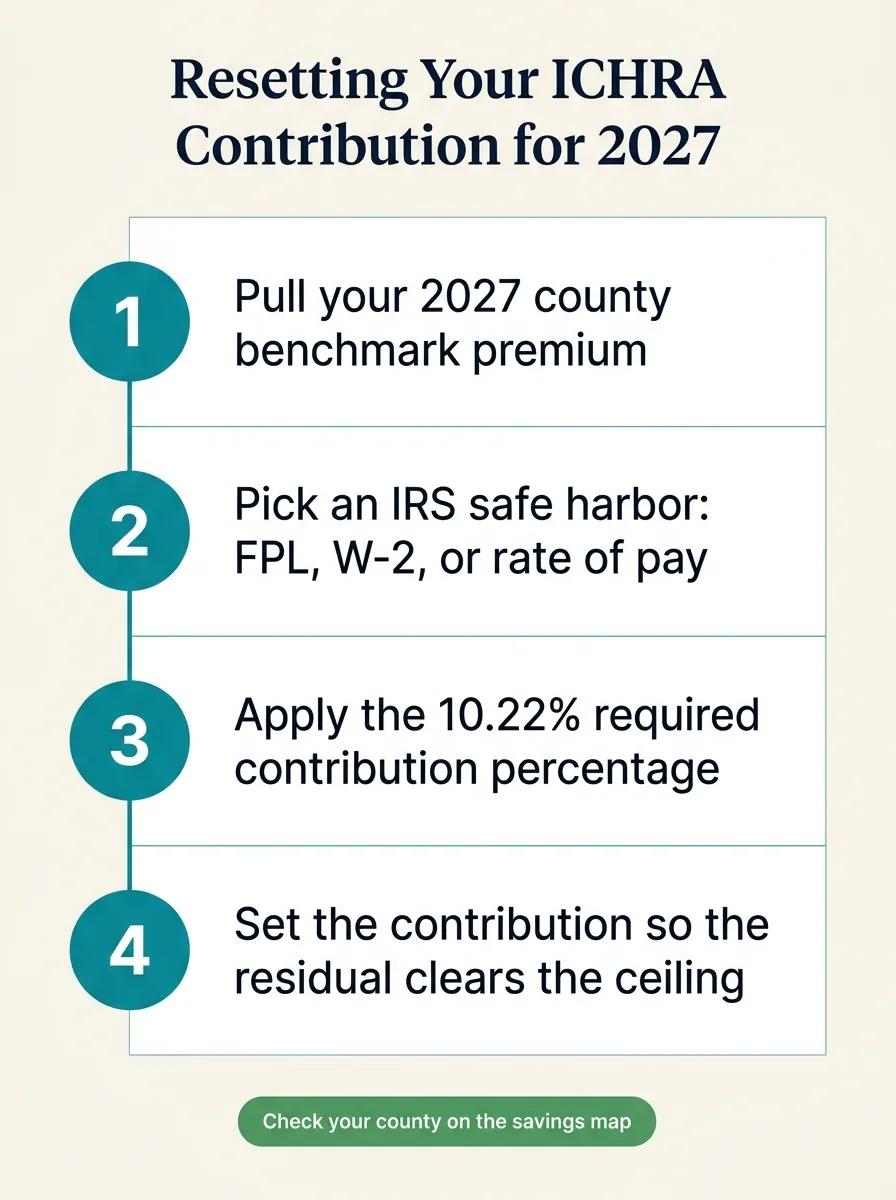
- Pull your county's current premium, not last year's. The individual-market benchmark used for your affordability math has to reflect this year's actual rates, not the number a contribution was originally built around.
- Pick a safe harbor that fits your workforce. The FPL safe harbor used throughout this article is the simplest; the W-2 wages or rate-of-pay safe harbors can allow a smaller contribution if actual employee income runs above the poverty-line assumption, and a benefits professional can help you choose.
- Apply the 2027 required contribution percentage, 10.22%, to whichever safe harbor you picked, not last year's 9.96% figure.
- Compare the employee's residual cost against that ceiling for every employee class, since different classes can have different contribution amounts by design.
- Raise the contribution to close any gap before your 2027 plan year begins, not after an employee has already declined the offer.
- Check your county on the savings map at the same time, since the affordability reset and the ICHRA-vs-small-group comparison are both local questions that use the same underlying premium data.
Do the reset before the notice goes out, not after
An ICHRA generally requires written notice to employees at least 90 days before the plan year begins. Running the affordability math after that notice is out means fixing a mistake in public rather than avoiding one. See the full setup timeline →
Checking your own counties
Everything above about the required contribution percentage, the FPL safe harbor, and the section 4980H penalties applies identically no matter where your team lives. Whether an ICHRA is still the cheaper way to offer coverage where your specific employees are is a separate, county-level question, and it is exactly what our savings map and dataset are built to answer, using 2026 plan-year rate data cross-verified against CMS public-use marketplace files.
If your 2027 renewal is already on the calendar, it is worth a conversation: talk to an advisor about your timeline → If you would rather see the mechanics first, start with how ICHRA works, or check your county directly: check your county on the savings map →
The percentage going up is not the bad news here. The bad news is assuming it means you can leave the contribution alone. It means the opposite: you have to run the math again, on purpose, every single year.
Mike MooreWhere this still does not favor ICHRA
It would be convenient to end here with "reset the number and an ICHRA wins everywhere." It does not, and this site's own data is the reason to say so plainly. Our dataset shows an estimated 20 to 62% savings range in qualified counties only, a range that describes where the individual-market benchmark premium already runs below the small-group benchmark for the 2026 plan year. Wisconsin has 5 such counties in our data; most of the state's other counties do not currently qualify. Colorado has 14, a larger number, but still a minority of the state's total counties, and Colorado's own preliminary 11% individual-market rate filing for 2027 is a reminder that the gap in any specific county can narrow, hold, or widen as both markets move.
The federal affordability math in this article decides whether a given contribution counts as compliant. It does not decide whether an ICHRA is the cheaper way to offer coverage in the first place; that is a county-specific comparison against small-group rates, and the two questions have to be answered separately, not assumed to move together.
What this does not guarantee
Read this before you act on any of the above
- This is not tax, legal, or HR advice. Whether a specific contribution clears the affordability test for a specific employee depends on facts this article cannot see.
- The FPL safe-harbor dollar figures in this article are calculations, not single numbers published by the IRS; confirm the current figure with a benefits attorney or administrator before relying on it for a compliance decision.
- Taking an ICHRA generally means an employee waives premium tax credit eligibility for any month the offer is deemed affordable for them. See our ACA subsidy cliff guide for the income thresholds involved.
- None of the figures in this article are an offer of insurance, a quote, or a guarantee of savings, coverage, or tax outcome for any specific employer or employee.
- ICHRA Savings is a private, independent advisory service and is not connected with or endorsed by the U.S. government, HealthCare.gov, the IRS, the Department of Labor, or CMS.
How these numbers are calculated
The 2027 required contribution percentage, 10.22%, and the 2027 Applicable Percentage Table come directly from IRS Revenue Procedure 2026-26, published in Internal Revenue Bulletin 2026-31 on July 27, 2026 and fetched independently from both the standalone PDF at IRS.gov and the bulletin index page the same day this article was written. The 2026 comparison figure, 9.96%, comes from IRS Revenue Procedure 2025-25. The 2026 and 2025 federal poverty guidelines for a household of one, $15,960 and $15,650, come from the HHS notices published in the Federal Register on January 15, 2026 (91 FR 1797) and January 17, 2025, respectively. The FPL safe-harbor monthly ceilings are this article's own calculation, poverty guideline multiplied by the required contribution percentage and divided by twelve, and are not independently published by the IRS as single dollar figures. The 2027 section 4980H(a) and 4980H(b) penalty amounts, $3,780 and $5,670, come from IRS Revenue Procedure 2026-22. The national small-group premium figure, a 14% median proposed increase for 2027, comes from the Peterson-KFF Health System Tracker's analysis published August 6, 2026, covering preliminary rate filings from roughly 300 insurers across all 50 states and D.C. The Colorado individual-market figure, an 11% average preliminary increase for 2027, comes directly from the Colorado Division of Insurance's press release dated July 22, 2026.
The Wisconsin and Colorado county figures come from the same dataset that powers our savings map: a 2026 individual-market benchmark premium, the second-lowest-cost silver plan available to a representative enrollee, compared against a small-group benchmark premium built from comparable small-group filings for that rating area. Both figures come from Ideon, a licensed insurance rate-data provider, cross-verified against CMS public-use marketplace files before publication.
One limitation worth stating plainly: the illustrative 8% Jefferson County premium increase used in the worked example above is a hypothetical chosen to demonstrate the mechanism, not a sourced projection for that county's actual 2027 rate, which was not available in public rate-filing data at the time this article was written. Every real employer has its own county, its own current premium, and its own employee census. Use this article to understand how the reset works, then run your own numbers with your current county rate before setting a 2027 contribution.
Questions employers actually ask
What is the 2027 ICHRA and ACA affordability percentage?
Why did the affordability percentage go up again for 2027?
Does a higher affordability percentage help or hurt employers?
What is the FPL safe harbor, and what is the 2027 dollar figure?
Do I need to change my ICHRA contribution for 2027 if nothing else changed?
Does the 2027 percentage change the ACA employer mandate penalties?
Does this affect the ACA premium tax credit or the subsidy cliff too?
Does ICHRA still save money in every county even with rates moving?
| Figure | Value | Geography | Source |
|---|---|---|---|
| ACA/ICHRA required contribution percentage, plan years beginning 2027 | 10.22% | National | IRS Rev. Proc. 2026-26 (IRB 2026-31, July 27, 2026) |
| ACA/ICHRA required contribution percentage, plan years beginning 2026 | 9.96% | National | IRS Rev. Proc. 2025-25 |
| 2026 HHS federal poverty guideline, household of one (used for 2027 FPL safe harbor) | $15,960 | 48 contiguous states + DC | HHS/Federal Register, 91 FR 1797 (Jan. 15, 2026) |
| 2025 HHS federal poverty guideline, household of one (used for 2026 FPL safe harbor) | $15,650 | 48 contiguous states + DC | HHS/Federal Register, 90 FR (Jan. 17, 2025) |
| Derived FPL safe-harbor monthly ceiling, 2027 | ~$135.93/mo | 48 contiguous states + DC | Calculated: 2026 FPL x 10.22% ÷ 12 |
| Derived FPL safe-harbor monthly ceiling, 2026 | ~$129.90/mo | 48 contiguous states + DC | Calculated: 2025 FPL x 9.96% ÷ 12 |
| 4980H(a) penalty per full-time employee (minus first 30), plan year 2027 | $3,780 | National | IRS Rev. Proc. 2026-22 |
| 4980H(b) penalty per affected employee, plan year 2027 | $5,670 | National | IRS Rev. Proc. 2026-22 |
| National median proposed small-group premium increase, 2027 | 14% | National (~300 insurers, 50 states + DC) | Peterson-KFF Health System Tracker, Aug. 6, 2026 |
| Colorado individual-market preliminary requested rate increase, 2027 | 11% | Colorado | Colorado Division of Insurance press release, July 22, 2026 |
| Estimated ICHRA savings vs. small group, Jefferson County, WI | 25.6% ($1,301/yr per employee) | Jefferson County, WI | qualified_counties.json, 2026 plan year |
| Estimated ICHRA savings vs. small group, Mesa County, CO | 26.9% ($1,417/yr per employee) | Mesa County, CO | qualified_counties.json, 2026 plan year |
| Wisconsin qualifying counties and covered population | 5 counties, ~285K people | Wisconsin | qualified_counties.json, 2026 plan year |
| Colorado qualifying counties and covered population | 14 counties, ~440K people | Colorado | qualified_counties.json, 2026 plan year |
Sources
- IRS, Revenue Procedure 2026-26 (2027 ACA/ICHRA required contribution percentage and Applicable Percentage Table)
- IRS, Internal Revenue Bulletin 2026-31 (official publication of Rev. Proc. 2026-26, July 27, 2026)
- IRS, Revenue Procedure 2025-25 (2026 ACA/ICHRA required contribution percentage)
- IRS, Revenue Procedure 2026-22 (2027 section 4980H(a)/(b) penalty amounts)
- HHS, "Annual Update of the HHS Poverty Guidelines" (91 FR 1797, Jan. 15, 2026; 2026 FPL figures)
- HHS, "Annual Update of the HHS Poverty Guidelines" (Jan. 17, 2025; 2025 FPL figures)
- Peterson-KFF Health System Tracker, "How Much and Why Premiums Are Going Up for Small Businesses in 2027" (Aug. 6, 2026)
- Colorado Division of Insurance, "ACA Health Insurance Premiums for Individuals Expected to Increase by 11% in 2027" (July 22, 2026)
- ICHRA final rule: Departments of the Treasury/IRS, Labor, and Health and Human Services (2019)
- County-level premium comparison:
src/data/qualified_counties.json, 2026 plan year (Ideon rate data, cross-verified against CMS public-use marketplace files)