ICHRA in Columbus, Ohio 2026: All 88 Counties Qualify
Ohio small-group renewals rose 16% for 2026, but all 88 counties qualify for ICHRA savings. See Franklin County estimated 59.8% spread, sourced.

The short version
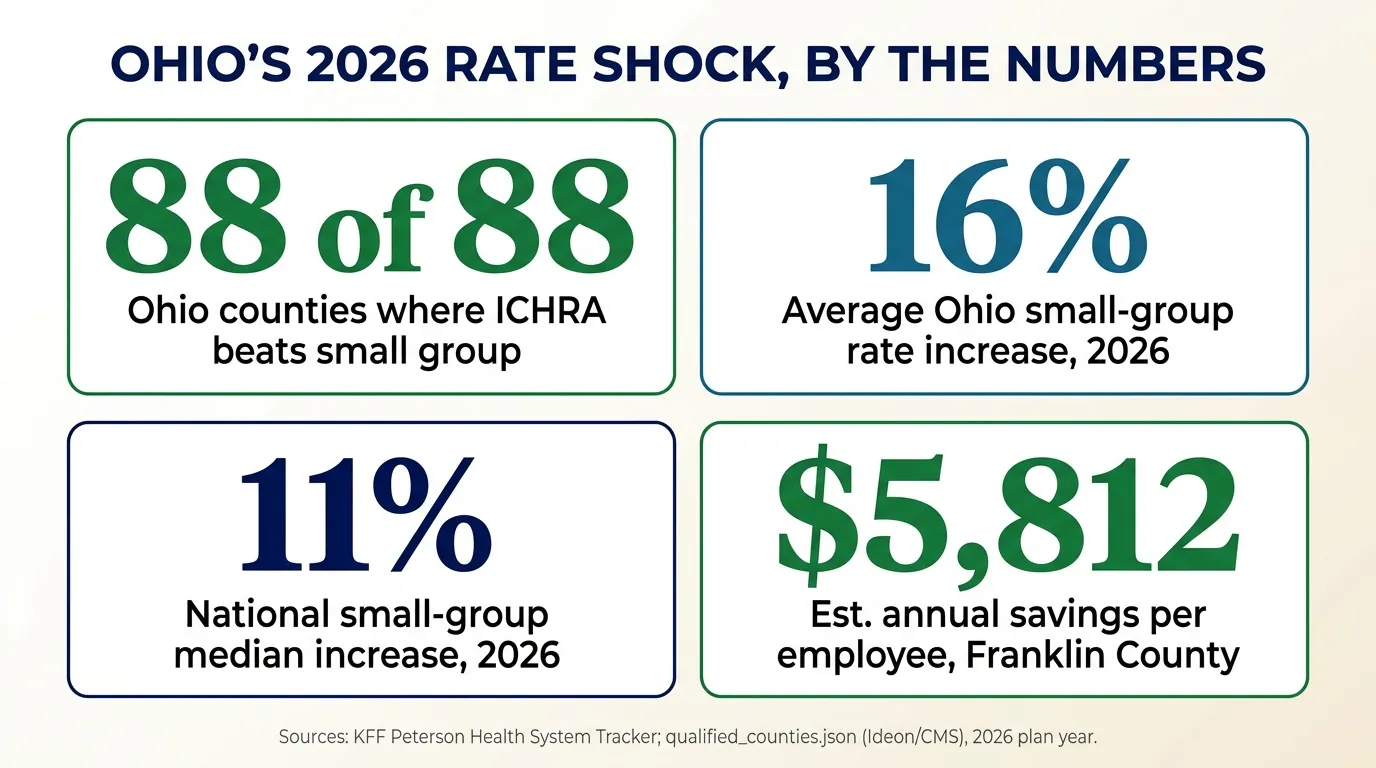
- Every one of Ohio's 88 counties currently prices individual-market coverage below the small-group benchmark for 2026 — the only state in our national dataset where 100% of counties qualify.
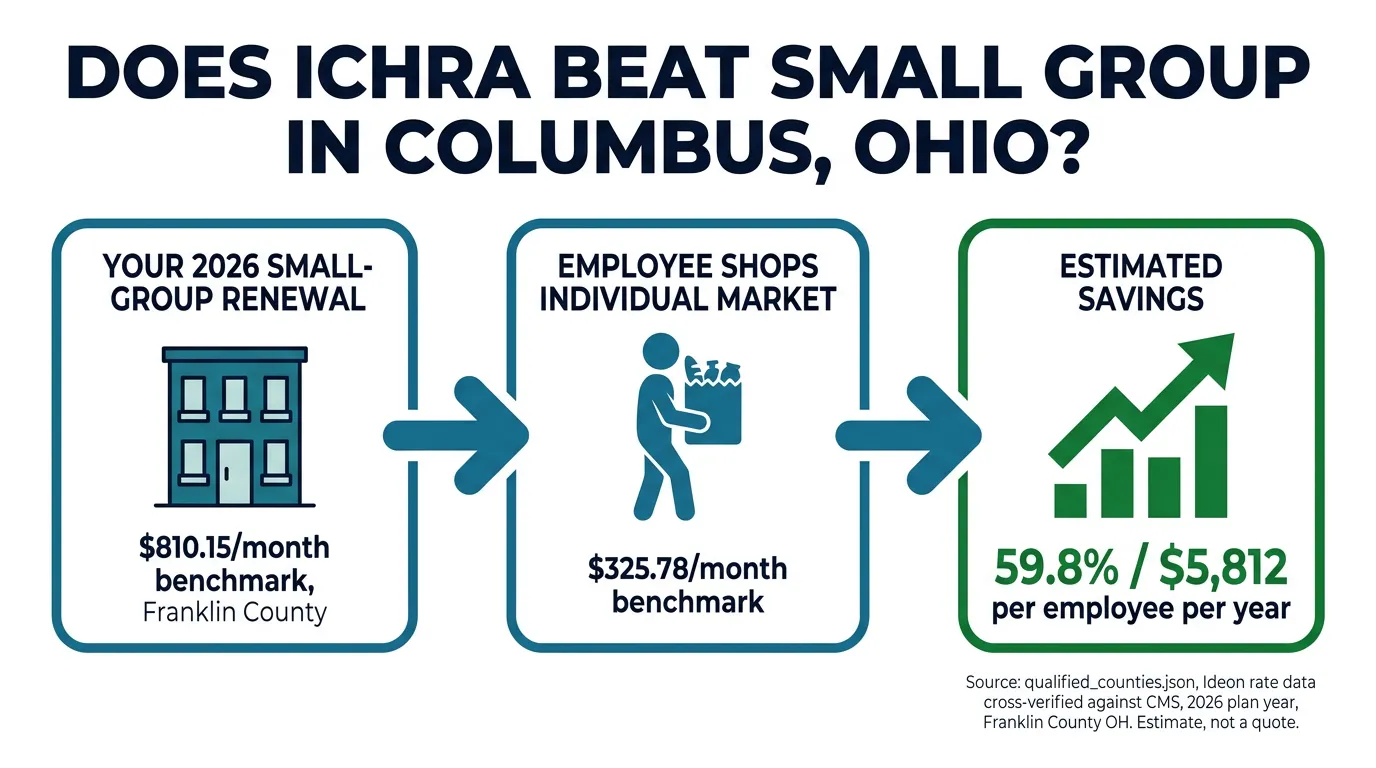
- In Franklin County (Columbus), that gap is an estimated 59.8%, or roughly $5,812 per employee per year, comparing a $325.78/month individual benchmark against an $810.15/month small-group benchmark.
- Ohio small-group carriers filed an average 16% rate increase for 2026, well above the 11% national median, which is the renewal shock driving a lot of this interest in the first place.
- Qualifying statewide is not the same as guaranteed savings for your business. The honest limits are covered later in this guide, including where the comparison breaks down for a specific workforce.
Does ICHRA beat small group in Columbus, Ohio?
Yes, on the numbers behind the 2026 plan year. An ICHRA (Individual Coverage Health Reimbursement Arrangement) is an IRS-defined arrangement that lets an employer set a fixed monthly reimbursement amount and let each employee buy their own individual-market plan with it, tax-free. In Franklin County, the Ohio county that contains Columbus, the 2026 individual-market benchmark premium runs an estimated 59.8% below the small-group benchmark premium, according to a county-by-county comparison built from Ideon rate data and cross-verified against CMS public-use marketplace files.
What makes Ohio different from most states we've covered is that this isn't a Columbus story alone. Every one of Ohio's 88 counties currently sits on the same side of that comparison for 2026: the individual benchmark is cheaper than the small-group benchmark everywhere in the state, from downtown Columbus to the smallest rural county on the Indiana line. Of the 719 counties nationwide where our dataset shows ICHRA beating small group, Ohio alone contributes 88 of them, or 12% of the national total, out of a state with only 88 counties total.
That is a genuinely unusual finding, and we treat it carefully rather than as a marketing headline. It does not mean every Ohio employer saves money by switching. It means the county-level obstacle that rules out ICHRA entirely in states like Florida or narrows it to a couple of counties in Texas simply isn't present in Ohio right now. The real question for a Columbus employer is how big the gap is for their specific workforce, and whether an ICHRA rollout is worth the administrative change. That's what the rest of this guide works through.
88/88
Ohio counties where ICHRA beats small group in 2026
59.8%
Estimated Franklin County savings vs. small group
11.8M
Ohioans living in a qualifying county
$5,812
Est. Franklin County savings per employee, per year
Why your 2026 renewal came in high
If you run a small business in Columbus and your broker's renewal letter landed with a bigger number than last year, you are not imagining it and you are not alone. For the 2026 plan year, Ohio's small-group carriers filed rate increases averaging about 16%, according to KFF's Peterson Health System Tracker, published September 24, 2025. A separate, independent tally from ACA Signups, updated August 29, 2025, put the unweighted average Ohio small-group increase at roughly 16.3% across filed carriers. Both land in the same neighborhood, and both sit well above the 11% national median increase KFF found across 318 small-group insurers filing in all 50 states and the District of Columbia for 2026.
Nationally, 68% of the 318 insurers KFF reviewed proposed increases between 5% and 15%, and about 10% (31 insurers) proposed 20% or more. Only three insurers nationwide requested a rate decrease. Ohio's carriers landed toward the higher end of that national spread, not the middle.
Insurers point to a consistent set of reasons in their own rate filings, not analyst speculation: underlying medical cost trend running near 9% a year, rising utilization of specialty and GLP-1 drugs (cited by 27 of the 96 insurers KFF examined in detail), higher labor costs inside the healthcare system, tariff-related cost pressure (cited by 23 of 96 insurers), and a shrinking, increasingly higher-risk small-group enrollment pool as more employers shift workers to self-insured arrangements or drop group coverage altogether.
| Metric | Ohio | National |
|---|---|---|
| Average small-group rate filing | ~16% (16.3% unweighted) | 11% median (318 insurers, 50 states + DC) |
| Share of insurers filing 20%+ | Among the higher end of state filings | ~10% of insurers (31 of 318) |
| Average individual-market rate filing | 19.8% weighted avg. (10 of 12 carriers) | Varies by state |
| Marketplace enrollees affected (individual) | ~583,000 Ohio residents | 24.2M (2025) → 23.1M signups (2026) |
| Cited cost drivers | Medical trend ~9%, GLP-1/specialty drugs, labor, risk-pool shrinkage | Same drivers nationally |
There's a second, separate story on Ohio's individual ACA marketplace: 10 of 12 carriers filed a weighted average rate change of 19.8% for 2026, according to ACA Signups' tracking (updated September 19, 2025), and a separate review of the Ohio Department of Insurance's filings found all 11 companies selling ACA plans in the state proposed increases, with a median near 18% and two carriers exceeding 30%, affecting roughly 583,000 Ohio residents on the federal marketplace, per reporting from Signal Cleveland (August 25, 2025). That individual-market number is not the same figure as the small-group renewal number above — they are two different markets — but both are moving up together, and both matter to a Columbus employer: the small-group number is what your current renewal costs, and the individual-market number is part of what determines whether an ICHRA-funded plan is a good deal for your employees.
Why a rising individual market doesn't cancel out ICHRA's savings
Individual-market premiums went up in Ohio for 2026, but so did small-group premiums, and by a similar or larger margin. What matters for the ICHRA math is not whether individual premiums rose — it's whether they rose relative to small-group premiums in the same county. In Franklin County, the gap is still an estimated 59.8% for 2026, which means both markets moved up together without closing the spread.
How an ICHRA actually works, mechanically
Before the Franklin County numbers mean anything, it helps to know exactly what's being compared and what each term means, since most of the confusion around ICHRA comes from skipping this step.
An ICHRA is an employer-funded health reimbursement arrangement created by a 2020 final rule from the IRS, the Department of Labor and HHS. Instead of choosing one group health plan for everyone, the employer sets a fixed monthly reimbursement amount, and each employee uses that money to buy an individual-market plan of their own choosing, then submits proof of coverage (called substantiation) to get reimbursed tax-free. The employer isn't picking a plan for 40 different households; the employer is funding a budget, and the employee is doing the shopping.
The comparison behind every number in this article rests on two specific prices for a given county and rating area, which is the geographic zone insurance regulators use to set premiums, usually a group of neighboring counties. The individual-market benchmark premium is the second-lowest-cost silver-level plan available in that rating area to a representative 40-year-old enrollee — "silver" refers to one of four ACA metal levels (bronze, silver, gold, platinum) that describe how costs split between premium and out-of-pocket spending, not the quality of care. This is the same benchmark the federal government uses to calculate premium tax credits, which is why it's a defensible number to build a comparison on rather than one insurer's list price. The small-group benchmark premium is the equivalent figure built from comparable small-group plan filings for that same rating area. When the individual benchmark is lower, the county "qualifies," and the gap between the two is the estimated per-employee savings if the employer funds ICHRA at that benchmark level.
Two more terms matter once an employer is actually deciding whether to switch. MOOP, or maximum out-of-pocket, is the most a plan can require an enrollee to pay in a year before it covers 100% of costs; it varies by the specific plan an employee chooses, not by the benchmark. And the affordability safe harbor is the test that decides whether the ICHRA offer counts as "affordable" under IRS rules, which in turn decides whether an employee keeps or loses eligibility for a premium tax credit — get the contribution amount wrong and an employer can trigger a penalty tied to the employer mandate, the ACA requirement that applies to ALEs (applicable large employers, generally 50 or more full-time-equivalent employees). Smaller, non-ALE employers aren't subject to that mandate at all, which is part of why smaller Columbus businesses have an easier on-ramp than larger ones.
One structural piece often misunderstood: an employer can define different employee classes — for example, full-time versus part-time, or by geographic rating area — and offer different benefits to each class, subject to federal minimum-size rules for some class types. What an employer cannot do is offer the same class of employees a choice between ICHRA and a traditional group plan; it's one or the other, per class, not both at once for the same people. That single rule trips up more Columbus employers during setup than almost anything else in the federal framework.
Franklin County's rate spread, in dollars
Here is the actual 2026 benchmark comparison for Franklin County, the county that contains Columbus, Bexley, Dublin, Gahanna, Grove City, Grandview Heights, Hilliard, Upper Arlington, Westerville and Whitehall. The individual-market benchmark premium — the second-lowest-cost silver plan available to a representative enrollee, the same benchmark the federal government uses to calculate premium tax credits — is $325.78 a month. The small-group benchmark premium, built from comparable small-group plan filings for the same rating area, is $810.15 a month. That's a gap of $484.37 a month, or $5,812.44 a year, per employee, an estimated 59.8% in favor of the individual market.
Franklin County is also Ohio's most populous qualifying county by a wide margin, at 1,318,149 residents, which means the county carrying the state's biggest workforce also carries one of its widest rate spreads. That combination — a big population and a wide spread at the same time — is unusual. Georgia's highest-savings counties, for comparison, tend to be small rural counties with fewer than 20,000 residents; Ohio's pattern runs the opposite way, with big metro counties posting some of the state's strongest numbers.
| County | Population | Savings vs. small group | Est. annual savings / employee |
|---|---|---|---|
| Franklin (Columbus) | 1,318,149 | 59.8% | $5,812 |
| Cuyahoga (Cleveland) | 1,256,620 | 51.2% | $4,125 |
| Hamilton (Cincinnati) | 827,671 | 61.7% | $5,643 |
| Summit (Akron) | 539,361 | 36.6% | $2,195 |
| Montgomery (Dayton) | 536,121 | 59.6% | $5,471 |
| Lucas (Toledo) | 430,014 | 56.4% | $5,136 |
| Butler (Cincinnati metro) | 388,327 | 61.7% | $5,643 |
| Stark (Canton) | 374,199 | 33.1% | $1,985 |
Notice that Summit County (Akron) and Stark County (Canton) qualify at meaningfully lower percentages, 36.6% and 33.1%, than the Columbus, Cincinnati and Dayton metros. That's the same lesson every county-level dataset teaches: a statewide "Ohio saves X%" headline would hide real variation between counties just a short drive apart. Check your own county, not a state average, before you model a rollout.
See the full Ohio savings breakdown for every qualifying county, or the national savings map to look up a specific county by name, including the counties that ring Columbus: Delaware, Fairfield, Licking, Pickaway, Union and Madison.
The whole Columbus rating area prices the same way
Franklin County doesn't stand alone. Delaware, Fairfield, Licking, Madison, Pickaway and Union Counties, the six counties that ring Columbus, sit in the same marketplace rating area and carry the identical 2026 benchmark comparison: a $325.78 individual benchmark against an $810.15 small-group benchmark, the same 59.8% spread and the same $5,812.44 estimated annual savings per employee. Combined, those seven counties hold an estimated 2,038,619 residents, so a Columbus-based employer with staff commuting in from Delaware, Grove City or Pickerington doesn't need to run a separate calculation for each location; the same math applies across the whole metro.
That's different from Georgia, where neighboring counties in the same metro can post meaningfully different spreads because they sit in different rating areas. In greater Columbus, the rating area itself is the unit that matters, and it happens to line up cleanly with how people actually commute in and out of the city.
Why every Ohio county qualifies, and what that does not mean
A qualifying county means the individual-market benchmark premium sits below the small-group benchmark premium for that county, for the 2026 plan year, based on the rate filings each carrier submitted. Ohio's small-group carriers filed some of the highest increases in the country this cycle, which pushes small-group benchmarks up. At the same time, the state's individual market, spread across a smaller number of ACA marketplace carriers than some larger states, has not seen its benchmark premiums rise by enough to close that gap in any county. The net effect for 2026 is that all 88 counties land on the ICHRA side of the comparison, not just Franklin.
This is a real, dataset-driven finding, not a promotional claim, and it is also not permanent. Rates are filed and refreshed every plan year. A single large carrier entering or exiting even one Ohio county's individual market could shift that county's benchmark enough to change the comparison for 2027. We rebuild this dataset each plan year rather than reusing prior-year numbers, and we'd recommend any Ohio employer do the same before every renewal, not just once.
Part of the mechanical explanation is that small-group and individual-market premiums are set through different processes that don't have to move together. Small-group rates are built from a carrier's expected claims for that specific book of business plus administrative load, and Ohio's 2026 filings leaned heavily on rising medical trend and drug utilization, the same drivers cited above. Individual-market rates, by contrast, are set against the ACA's single statewide risk pool and its own utilization trend, and enough carriers are still competing for that business in every Ohio county that the individual benchmark hasn't caught up to small-group pricing anywhere in the state this cycle. Neither side of that comparison is fixed; it's simply where the two filed numbers landed for 2026.
It's also worth being precise about what "100% of counties qualify" does not mean. It does not mean every Ohio employer saves money by switching, and it does not mean the savings are the same size everywhere — Stark County's 33.1% spread is real money, but it is roughly half of Hamilton County's 61.7%. It does not account for your specific employees' ages, since individual-market premiums are age-rated more steeply in some rating areas than small-group premiums are. And it is a benchmark comparison, not a quote for any real plan a specific employee would actually choose.
Every Ohio county clears the bar this year. That tells you geography isn't your obstacle. It doesn't tell you what your own workforce will actually save.
Mike MooreA worked example for a Columbus employer
Here's what the Franklin County numbers look like applied to a real headcount. Assume a 15-employee Columbus company currently renewing a small-group plan priced at this year's Franklin County benchmark.
Here's the math
The 2026 small-group benchmark in Franklin County is $810.15 a month per employee, or $9,721.80 a year. The 2026 individual-market benchmark is $325.78 a month, or $3,909.36 a year. The difference is $5,812.44 a year per employee. For a 15-person company, funding ICHRA contributions at the benchmark level instead of renewing small group works out to an estimated $87,186.60 a year in aggregate savings.
This is illustrative math built from real 2026 county rate data and a hypothetical headcount. It is not a quote, and it assumes the employer sets the ICHRA contribution at the benchmark level, which is a design choice, not a requirement. Your actual number depends on your employees' ages, exact home counties, and the plans they choose once they're shopping with their own budget.
One thing this example deliberately does not do: it does not stack this year's 16% small-group renewal increase on top of the benchmark comparison. The $810.15 small-group figure already reflects 2026 rates, increases included, so the $5,812.44 gap is the actual 2026-to-2026 comparison, not a projection. If your carrier's specific renewal came in above the state average, your real gap is likely wider than this estimate, not narrower.
The same arithmetic scales down just as cleanly. A 5-person Columbus startup that has never offered health coverage at all, the scenario the HRA Council data below shows is now the norm rather than the exception, could fund an ICHRA at the $325.78 individual benchmark and offer a real, tax-free benefit for about $1,629 a month in total contributions, or roughly $19,547 a year for the whole company. That's a genuinely different conversation than trying to buy a five-person small-group plan, where participation minimums and per-employee pricing tend to make the smallest groups the hardest and most expensive to cover.
At the other end of the size range, a 50-employee Columbus company crosses into ALE territory under the employer mandate, which changes the calculus without changing the underlying county math. The same Franklin County benchmark comparison applies, but an ALE has to run the affordability safe-harbor test carefully for every employee class, since an ICHRA offer judged "unaffordable" for even a handful of lower-paid employees can trigger an employer-mandate penalty. That's not a reason to avoid ICHRA at 50 employees; it's a reason to model the affordability test before setting a contribution amount, which our eligibility guide walks through in detail.
How Ohio's 88 qualifying counties break down by savings tier
Number of counties in each savings band, 2026 plan year. Source: Ideon rate data, cross-verified against CMS public-use files.
No qualifying Ohio county falls below 30% savings, and none reaches 70%. Illustrative and rounded; not an offer of insurance or a guarantee of savings.
How ICHRA adoption is actually growing
Ohio's numbers sit inside a national adoption trend that keeps compounding. The HRA Council's most recent annual report, Growth Trends for ICHRA & QSEHRA, Vol. 4 (published January 2025, aggregating anonymized enrollment data from 15 member administration platforms), found that small, non-ALE ICHRA adoption grew 52% year over year among participating founding members, while large-employer (ALE) adoption grew 34% in aggregate, with some large-employer cohorts posting 49% growth.
The number that matters most for a Columbus employer weighing this for the first time: 83% of employers offering ICHRA or QSEHRA in 2025 had never previously offered any group coverage at all, while only 17% switched over from a traditional group plan. For most small Ohio businesses, the realistic comparison usually isn't "ICHRA versus our current group plan." It's "ICHRA versus offering nothing," which is a much easier case to make in a tight Columbus labor market where competitors are starting to offer something for the first time.
New coverage, not a switch
83% of 2025 ICHRA/QSEHRA employers had never offered coverage before.
Small employers are moving fastest
Small, non-ALE adoption is up 52% year over year among HRA Council founding members.
Large employers are following
Aggregate ALE adoption is up 34% year over year, with some cohorts up 49%.
Setting up an ICHRA in Columbus
Ohio does not layer state-specific ICHRA rules on top of the federal framework. The same IRS, Department of Labor and HHS final rule (2020) that governs ICHRA everywhere applies here, and the setup sequence is the same one that applies in any other state. What determines whether a Columbus rollout goes smoothly:
- Pull your census by county, not by office address. A company headquartered downtown with staff living in Delaware, Fairfield or Licking County has employees spread across several rating areas, and Columbus's collar counties don't all price identically.
- Check every employee's actual county on the savings map. Given that all 88 Ohio counties currently qualify, this step is less about ruling counties out and more about sizing the real dollar gap for your specific workforce.
- Model affordability before you set a contribution. The reimbursement level decides whether an employee keeps or waives premium tax credit eligibility, which matters more with the 400% FPL cliff back in force for 2026.
- Define employee classes carefully, if you use them. Class rules carry minimum-size requirements and cannot offer the same class a choice between ICHRA and group coverage.
- Send the required notice on time. Eligible employees need written notice at least 90 days before the plan year starts, with specific required content.
- Budget for onboarding support. Employees who have never shopped the individual marketplace on their own need guidance, once, at enrollment.
See our full ICHRA setup timeline for the detailed 60-day rollout plan, including the exact notice content requirements, and our eligibility guide for the affordability test itself.
If your employer just offered you an ICHRA
This guide is written for the employer side of the decision, but if you're a Columbus-area employee who was just told your benefit is changing, the short version is: you'll get a fixed monthly amount and shop for your own plan on the individual marketplace instead of picking from your employer's group menu. Our guide for employees walks through what to expect and how to use the reimbursement once you have it.
Run your counties first
Before scheduling a single meeting, look up every county where you actually have employees on the savings map. Franklin County's spread is wide, but if your workforce also has staff in Stark or Summit County, their numbers look different, and worth knowing before you set one contribution amount for the whole company.
The honest limits of this data
Qualifying statewide is not a guarantee for your business
- A benchmark comparison is not your actual renewal. The $810.15 Franklin County figure is a small-group benchmark built from filed rates, not your specific carrier's quote for your specific group.
- Older or higher-risk workforces change the math. Individual-market premiums are age-rated more steeply in some Ohio rating areas than small-group premiums, which can narrow real-world savings for an older team.
- Rates move every plan year. A carrier entering or leaving a county can shift the comparison for 2027; recheck before every renewal, not just once.
- A qualifying county means the benchmark comparison favors ICHRA, not that every employee will pick a plan priced at the benchmark. Some employees will choose richer or leaner plans than the benchmark, which changes their individual premium without changing the underlying spread.
How these numbers are calculated
Every county figure in this article comes from the same dataset that powers our savings map, not a survey or a sales estimate. For each county, we compare a 2026 individual-market benchmark premium — the second-lowest-cost silver plan available to a representative enrollee, the same benchmark the federal government uses to calculate premium tax credits — against a small-group benchmark premium built from comparable small-group plan filings for that rating area. Both figures come from Ideon, a licensed insurance rate-data provider, and are cross-verified against CMS public-use marketplace files before publication. A county "qualifies" when the individual benchmark sits below the small-group benchmark; the percentage and dollar figures in this article are the gap between those two numbers, expressed as an annual per-employee figure at 12 times the monthly difference.
The 2026 Ohio and national small-group renewal figures (16%, 16.3% and 11%) come from separately published rate-filing analyses — KFF's Peterson Health System Tracker and ACA Signups — not from our own county dataset, and they describe filed carrier rate increases, not the benchmark premiums used in the county comparison above. We've kept those two data sources clearly separate throughout this article rather than blending them into one number.
Three limitations are worth stating plainly. First, benchmark premiums are built around a representative enrollee profile, so an unusually young or unusually old workforce will see a different real-world spread than the county figure implies. Second, these are benchmark plans, not every plan on the market; an employee who chooses a richer or leaner plan than the benchmark will see a different premium, though the relative spread tends to hold directionally. Third, rates are filed and refreshed annually, so a county that qualifies for 2026 is not guaranteed to qualify for 2027 if a carrier enters or exits that market.
Questions Columbus employers actually ask
Does ICHRA beat small-group insurance in Columbus, Ohio?
Yes, on the current 2026 benchmark comparison. In Franklin County, the county that contains Columbus, the individual-market benchmark premium runs an estimated 59.8% below the small-group benchmark, about $5,812 per employee per year. That is an estimate built from public and industry rate data, not a quote, and your actual result depends on your employees’ ages and the plans they choose.
Why did every county in Ohio qualify, not just Columbus?
All 88 of Ohio’s counties currently price the individual-market benchmark below the small-group benchmark for 2026, which makes Ohio the only state in our national dataset where 100% of counties qualify. The average spread is 53.7%, ranging from 33.1% in Stark County to 62.3% in Morrow County. We don’t treat that as a guarantee for any specific employer, since real-world savings depend on your workforce, but it does mean geography is not the limiting factor for an Ohio employer the way it is in states like Texas or Florida.
How much can a Franklin County employer expect to save?
Using 2026 benchmark data, the estimated gap in Franklin County is $484.37 a month, or $5,812.44 a year, per employee. For a 15-person company, that is roughly $87,000 a year in aggregate estimated savings if the employer funds ICHRA contributions at the benchmark level instead of renewing small group. This is illustrative math from public rate data, not a projection of what any specific employer will actually pay.
Why did my 2026 small-group renewal come in higher than I expected?
Ohio’s small-group carriers filed an average 16% rate increase for 2026, well above the 11% national median across 318 insurers, according to KFF’s Peterson Health System Tracker and a separate unweighted analysis from ACA Signups that put the Ohio figure at about 16.3%. Insurers cite rising medical trend near 9%, GLP-1 and specialty drug utilization, labor costs, and a shrinking, higher-risk enrollment pool as the main drivers.
Does Ohio impose any state-specific ICHRA rules?
No. ICHRA is a federal HRA structure created by a 2020 final rule from the IRS, the Department of Labor and HHS, and it works the same way in Ohio as in any other state. The Ohio Department of Insurance reviews carrier rate filings for the small-group and individual markets, but it does not add ICHRA-specific requirements on top of the federal rule.
What happens to my employees' premium tax credit if I switch to ICHRA?
An employee who is offered an affordable ICHRA generally becomes ineligible for a premium tax credit for any month that offer applies, whether or not they accept it. That trade-off matters more with the 400% FPL subsidy cliff back for 2026 coverage. Our separate guide on the ACA subsidy cliff walks through the income thresholds by household size.
Can I offer ICHRA to my Columbus employees and keep group coverage elsewhere?
You can offer different benefits to different permitted employee classes, including a class defined by rating area or full-time versus part-time status, but you cannot offer the same class a choice between ICHRA and a traditional group plan. Setting up classes correctly is one of the most common places an Ohio employer needs help from a benefits attorney or a qualified advisor.
Where can I check the numbers for my specific Columbus-area county?
Use the savings map to look up any Ohio county by name, including Franklin, Delaware, Fairfield, Licking, Pickaway, Union and Madison, the counties that ring Columbus. It shows the 2026 individual-market and small-group benchmark premiums side by side so you can see the estimated spread before modeling a rollout for your own workforce.
Sources
- Peterson-KFF Health System Tracker, "How Much and Why Premiums Are Going Up for Small Businesses in 2026" (Sept. 24, 2025)
- ACA Signups, "2026 Gross Rate Changes: Ohio" (updated Sept. 2025)
- Signal Cleveland, "ACA Health Insurance Premiums Expected to Rise in Ohio Next Year" (Aug. 25, 2025)
- HRA Council, "Growth Trends for ICHRA & QSEHRA, Vol. 4" (Jan. 2025)
- ICHRA final rule: Departments of the Treasury/IRS, Labor, and Health and Human Services (2020)
- County-level premium comparison:
src/data/qualified_counties.json, 2026 plan year (Ideon rate data, cross-verified against CMS public-use marketplace files)