ICHRA for Remote Teams in 2026: The Multi-State Fix
A remote team across six states gets six different ICHRA outcomes in 2026. See where it beats small group, county by county, and where it does not.
The short version
- ICHRA is not "remote-friendly" by marketing accident. Employee classes can be built around state or rating-area geography under federal rule 26 CFR § 54.9802-4, which is exactly the structure a distributed team needs.
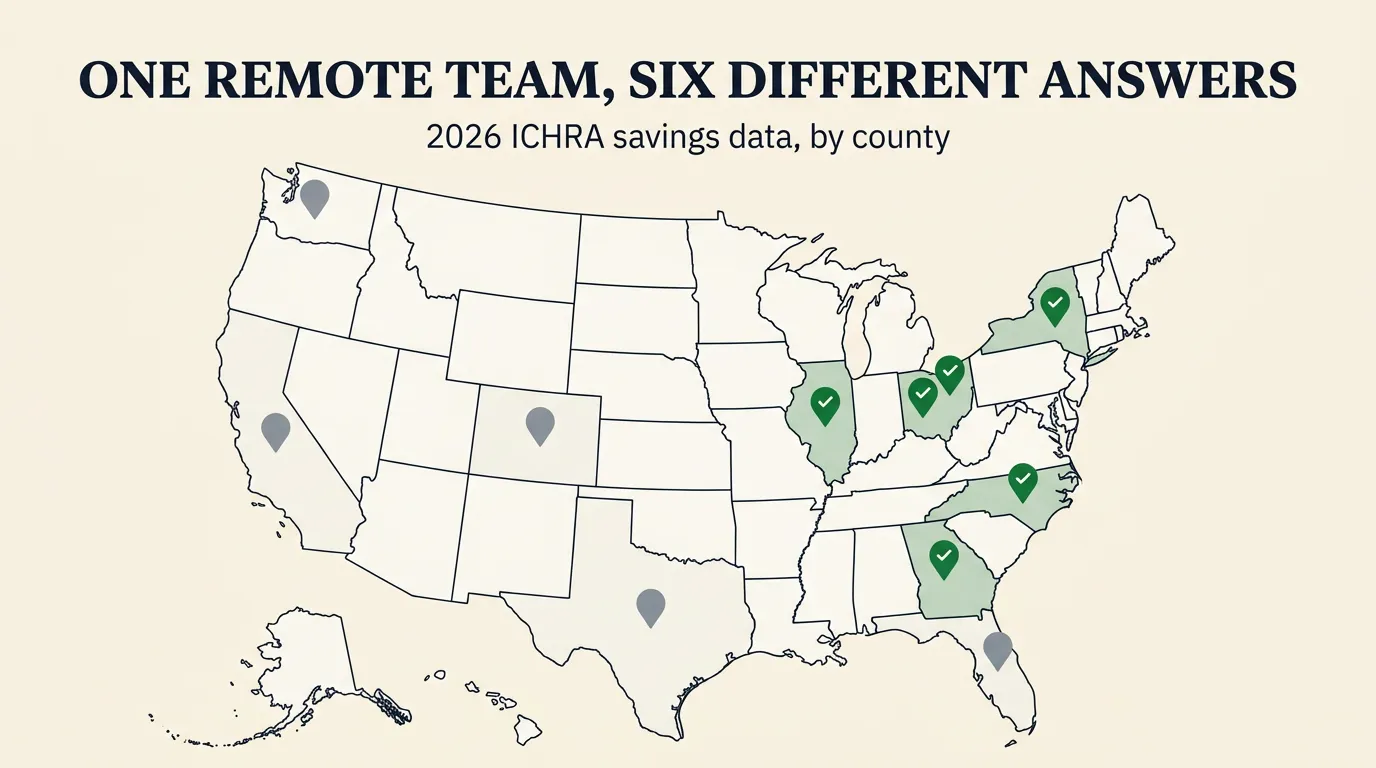
- For six team members in this article's example, living in Cincinnati, Columbus, Brooklyn, Chicago, Savannah and Charlotte, the 2026 individual-market benchmark currently runs 38.8% below the small-group benchmark on average, an estimated $19,678.80 a year combined.
- For the other six, living in Austin, Los Angeles, Seattle, Denver, Atlanta and Miami, that same rate-spread case does not currently apply. Their counties are not in the qualifying dataset. ICHRA can still solve the network and participation problem there, just not the savings-versus-small-group problem this year.
- 13.8% of US workers worked from home in 2023, per the Census Bureau, up from 5.7% in 2019 — the multi-state hiring problem is not shrinking.
- These are estimates from 2026 plan-year benchmark data, not quotes, and starting an ICHRA generally means an employee waives the premium tax credit for that month.
Does ICHRA actually work for a remote team?
Yes, mechanically, for any team spread across any number of states. An Individual Coverage HRA (ICHRA) does not route your employees through one insurance network the way a small-group plan does. Each employee buys their own plan on the individual market where they live, and you reimburse them tax-free up to a monthly amount you set. Whether that employee is down the hall or in a state you have never visited does not change the mechanics.
What does change, state by state and county by county, is whether ICHRA is the cheaper option than small-group coverage. That is a separate question from whether it works, and this article keeps the two apart on purpose. Six real counties below show where the 2026 numbers currently favor ICHRA on cost, and six show where they currently do not. Both facts matter to a company deciding how to cover a distributed team, and neither one is the whole story on its own.
The network problem
A small-group plan is built around one network. A remote team needs one that works everywhere its people live.
The participation problem
Carriers set minimum enrollment percentages to keep a group plan active. A scattered team makes that minimum harder to hit.
The cost question
Separate from both of those: does the individual market actually cost less than small group in each employee's specific county?
Why one plan never fits a distributed team
Picture a 12-person company with nobody in the same state twice. Two people in Ohio, one in Brooklyn, one in Chicago, one in Savannah, one in Charlotte. The other six are in Austin, Los Angeles, Seattle, Denver, Atlanta and Miami. This is not a hypothetical stress test; it is a fairly ordinary shape for a company that hires the best person for the job instead of the best person within commuting distance of an office that no longer exists.
A traditional small-group health plan is not built for that company. Small-group insurance is licensed and regulated state by state, and a carrier's network of doctors and hospitals is built around the state, or often the metro area, where it does business. An employer trying to buy one small-group policy that gives every one of those twelve people a usable, in-network plan runs into the same wall from two directions: most small-group carriers simply do not sell in all ten of those states, and even a national carrier's small-group network in Ohio has nothing to do with its network in Washington.
The honest options for that employer, before ICHRA existed as a practical structure, were narrow: hire only where the group plan's network already reaches, buy a separate small-group policy in every state (a real administrative undertaking for a 12-person company), route everyone through a professional employer organization, or offer nothing to remote hires at all. None of those is a satisfying answer for a business trying to compete for talent nationally.
How small-group insurance breaks across state lines
A few terms are worth pinning down once, since the rest of this article leans on them. A rating area is a geographic zone, usually a county or group of counties, that insurers use to set premiums under ACA rules; it is why neighboring counties in the tables below often show identical benchmark figures. The individual-market benchmark premium is the second-lowest-cost silver plan available to a representative enrollee in a rating area, the same figure the federal government uses to calculate premium tax credits. The small-group benchmark premium is the comparable figure built from small-group plan filings for that same rating area. An employee class is a permitted way of grouping employees, including by full-time or part-time status, salaried or hourly status, or geography, so an employer can offer different terms to different groups.
Small-group insurance is regulated at the state level, which is precisely the source of the multi-state problem. A carrier has to be licensed in each state where it sells small-group coverage, build a provider network in that state, and file rates with that state's insurance department. None of that infrastructure travels automatically to the next state over. A company headquartered in Ohio with a single employee in Washington cannot simply add that person to its Ohio small-group plan and expect a usable network; Washington provider contracts are a different network entirely, built by a different regulatory process, priced against a different rating area.
The individual market works differently by design. Every county in the country has its own individual-market plans, sold by carriers licensed in that state, with networks built for that state. An employee who buys their own plan is automatically buying into whatever network actually functions where they live. The ICHRA structure just adds a tax-free way for the employer to fund that purchase, without the employer having to replicate a network anywhere.
What employers do instead, and what it costs them
Most small companies with a distributed team do not attempt state-by-state small group. It is not economical at a dozen employees. The realistic alternatives in the market today are a professional employer organization (PEO), which co-employs staff to access group-style benefits across states, or simply offering no group health benefit to remote hires and leaving them to buy individual coverage with no employer contribution at all. Both carry a real cost: the PEO route means giving up direct control of employment relationships and paying an ongoing services fee on top of premiums, and the no-benefit route means competing for talent with one hand tied behind your back.
The backdrop making that choice more expensive every year is the broader premium trend, which applies no matter which state an employee lives in. The median proposed ACA marketplace premium increase for 2026 was 18%, finalized at 20% once state regulators completed their review, according to the Peterson-KFF Health System Tracker. For 2027, the same tracker's analysis of 276 insurer filings across all 50 states and Washington, D.C., updated August 3, 2026, put the median proposed increase at 15% — the second-highest requested rate change since 2018, and a second consecutive year of double-digit increases. Whatever an employer chooses for a distributed team, the cost of not choosing anything keeps rising in the background.
KFF's 2025 Employer Health Benefits Survey, published October 22, 2025, found that 59% of firms with 10 to 199 workers offer health benefits at all, against 97% of firms with 200 or more workers. Flip that small-firm number around: an estimated 41% of companies in that size band offer nothing, nationally, in 2025. For a growing share of small, distributed companies, the real competitor to ICHRA is not small group. It is nothing.
The one federal rule built for exactly this
ICHRA was created by a 2020 federal final rule from the IRS, the Department of Labor and HHS, and it applies identically in every state. The part of that rule most relevant to a distributed team is the list of permitted employee classes in 26 CFR § 54.9802-4. An employer can group employees by full-time or part-time status, salaried or hourly status, waiting-period status, and, notably, by geographic location: an employee's primary site of employment can define a class if it is a rating area, a state, or a group of two or more entire states.
The class rules include a detail that matters directly to a small distributed company: minimum class size requirements, which normally require a class to include a certain number of employees before it can carry a different benefit design, do not apply when the geographic area defining the class is a state or a combination of two or more entire states, per the regulation. A rating area smaller than a state, like a single county, does trigger the minimum size rule unless another exemption applies. In practice, that means a 12-person company can legally set up a distinct "Ohio employees" class, a "New York employees" class, and so on, each with its own contribution amount, even if only one person lives in some of those states, so long as the class is defined at the state level rather than a narrower rating area.
What an employer cannot do is offer the same class of employees a choice between the ICHRA and a traditional group plan; a class gets one structure or the other, cleanly. That single constraint is where a first-time multi-state rollout most often trips up, according to the same rule that makes the rest of this workable.
One team, six counties, six different answers
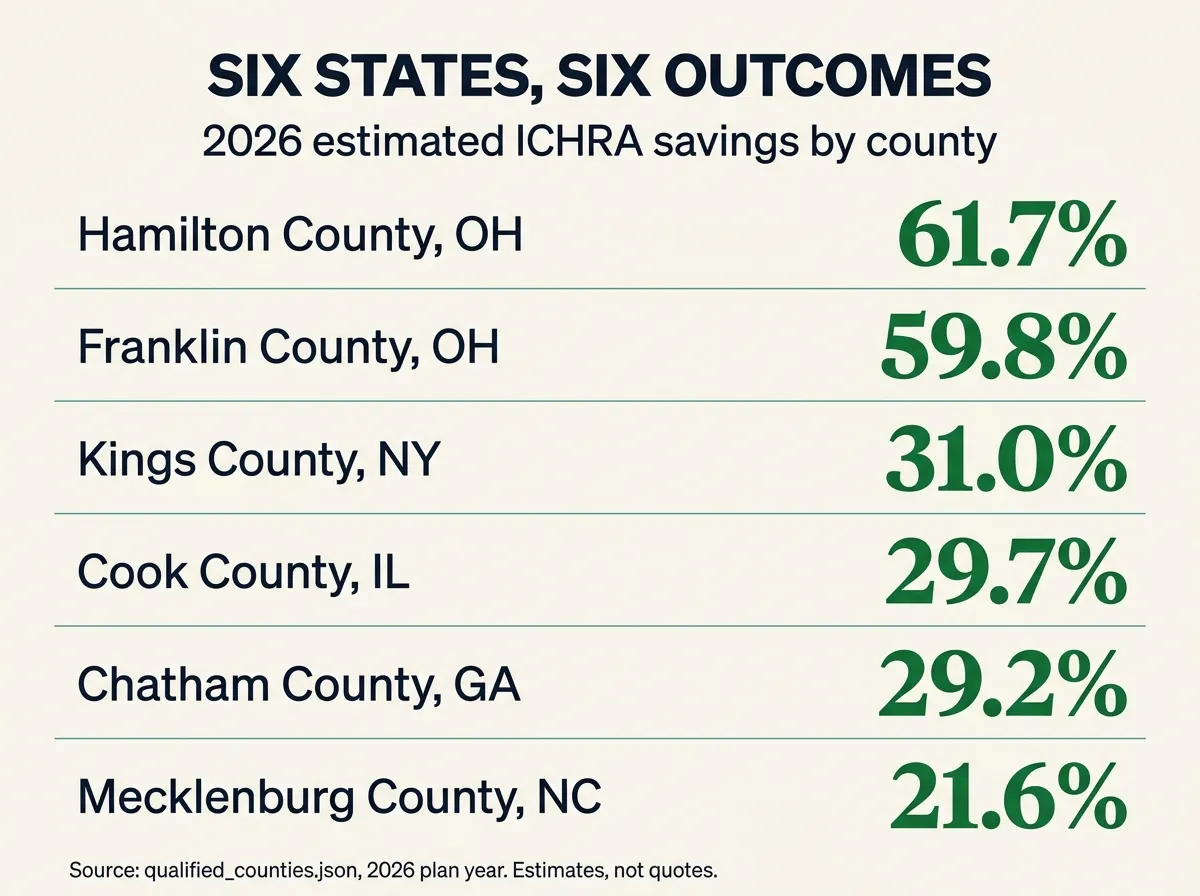
Here is where the honesty this site is built around matters most. Take the six team members in this article's example who live in counties that are part of the 719-county qualifying dataset for the 2026 plan year. Table 1, generated directly from that dataset, shows what the individual-market and small-group benchmarks actually look like where each of them lives.
| Team member lives in | County | Individual benchmark (mo.) | Small-group benchmark (mo.) | Estimated spread | Est. annual savings |
|---|---|---|---|---|---|
| Cincinnati, OH | Hamilton County | $292 | $762 | 61.7% | $5,643 |
| Columbus, OH | Franklin County | $326 | $810 | 59.8% | $5,812 |
| Brooklyn, NY | Kings County | $647 | $939 | 31.0% | $3,495 |
| Chicago, IL | Cook County | $302 | $429 | 29.7% | $1,532 |
| Savannah, GA | Chatham County | $401 | $566 | 29.2% | $1,984 |
| Charlotte, NC | Mecklenburg County | $366 | $467 | 21.6% | $1,212 |
Source: src/data/qualified_counties.json, 2026 plan year (Ideon rate data,
cross-verified against CMS public-use marketplace files). Estimates, not quotes; illustrative
city assignments for a hypothetical 12-person distributed team.
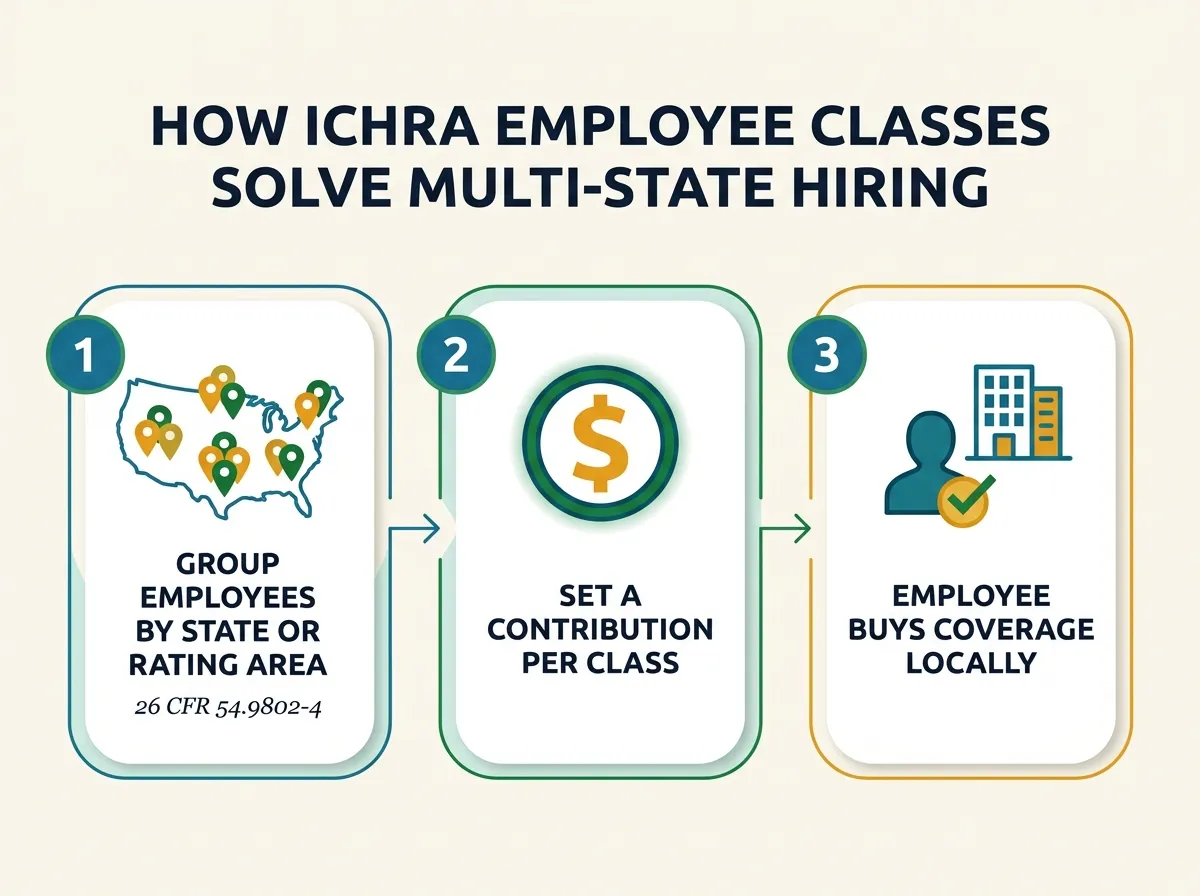
Hamilton County, Ohio (Cincinnati) shows the widest spread in this group at 61.7%, and Cook County, Illinois (Chicago) the narrowest among the six qualifying counties at 29.7%. Notice that spread and population do not move together: Cook County alone holds more people in this dataset, 5,225,367, than the other five qualifying counties in this table combined, yet it shows one of the smaller percentage spreads. A distributed team cannot infer one county's number from another, even within the same table.
38.8%
Average estimated spread across the six qualifying counties
6 of 12
Team members in a qualifying county, in this example
61.7%
Widest spread in the group, Hamilton County, OH
2026
Plan year in the dataset
The math for the six counties that qualify
Add up the six rows in Table 1 and the picture gets concrete. Funding those six employees at their local individual-market benchmark would cost an estimated $28,005 a year combined. Small-group coverage priced at the same six counties' benchmark would run an estimated $47,684 a year. The difference, $19,679 across six people, or $3,280 per employee on average, is the 2026 rate-spread effect in these specific counties. This is a benchmark comparison, not a quote for any real business, and it does not include a plan design decision an employer would still have to make.
One flat contribution, illustrated
Suppose this employer, instead of tailoring an amount to each county, chose one round, company-wide ICHRA contribution of $450 a month per employee, applied to all twelve team members regardless of state. The total annual cost is fixed and known in advance: 12 employees × $450 × 12 months = $64,800 a year. Compare that to the six-state small-group problem this article opened with, where a single comparable group policy covering all twelve people, across ten states, is not a product most small-group carriers can sell at all. The ICHRA number is not necessarily cheaper in every county; it is a number the employer can actually write down before the plan year starts, which a ten-state small-group patchwork rarely is. This $450 figure is a chosen illustration, not a recommended amount for any specific business.
The other six: honest limits, not a sales pitch
The other six team members in this example live in Austin, Los Angeles, Seattle, Denver, Atlanta and Miami. None of those counties, Travis, Los Angeles, King, Denver, Fulton or Miami-Dade, appear in the 719-county qualifying dataset for 2026. That does not mean ICHRA is unavailable to them. It means the specific claim this article is making about the other six, that the individual-market benchmark currently prices below the small-group benchmark, does not currently hold in their counties, and we do not have a sourced benchmark spread to publish for a county that is not in the dataset.
For those six employees, an ICHRA still removes the two structural problems described earlier: there is no carrier participation minimum to hit, and each person still buys a plan with a network that actually functions where they live, which a small-group plan headquartered in Ohio cannot promise them. What an employer should not do is tell a Seattle or Los Angeles employee that ICHRA will save them money against small group this year, because on this dataset, in their specific county, that is not currently the claim the numbers support.
California illustrates the point at a state level: zero California counties currently appear in the qualifying dataset, meaning the individual-market benchmark does not currently price below small group anywhere in the state on this comparison. Florida is the same, at zero qualifying counties. A distributed team with concentrations of people in either state should expect the rate-spread argument to carry no weight there this year, even while it carries real weight for their Ohio or Georgia colleagues.
It even varies inside a single state
The Texas, Washington and Colorado examples in this article make a sharper point still: a single state can contain both a qualifying county and a major metro that does not qualify, at the same time.
| State | Qualifies (2026) | Estimated spread | Does not currently qualify |
|---|---|---|---|
| Texas | Cottle & Knox counties (rural, pop. 1,647 and 3,333) | 23.5% | Travis (Austin), Harris (Houston), Dallas |
| Washington | Pierce County (Tacoma, pop. 918,993) | 26.7% | King County (Seattle) |
| Colorado | Mesa County (Grand Junction, pop. 156,131) | 26.9% | Denver County |
| Georgia | Chatham County (Savannah) | 29.2% | Fulton County (Atlanta) |
Source: src/data/qualified_counties.json, 2026 plan year. Only 2 of Texas's 254
counties currently qualify, statewide.
Only two of Texas's 254 counties currently show a rate-spread advantage, and both are thinly populated rural counties, not the Austin, Houston or Dallas metros where most remote hires in Texas actually live. A company that assumed "Texas is a qualifying state" from a state-level headline, without checking the specific county, would be wrong for nearly every Texas employee it actually has. This is the same reason our county-level dataset exists at all: state and national averages hide exactly the detail that decides your answer.
Why distributed teams are driving ICHRA growth
The remote-work backdrop behind this whole problem is not shrinking. According to the U.S. Census Bureau's American Community Survey data, 13.8% of US workers worked from home in 2023, more than double the 5.7% figure from 2019, even after settling down from a peak of 17.9% in 2021. A meaningful and growing share of the workforce is now, by definition, not sitting inside whatever network a local small-group plan was built around.
ICHRA adoption is moving in the same direction. The HRA Council's "Growth Trends for ICHRA & QSEHRA" report, Volume 4, based on data voluntarily shared by fifteen member organizations through early 2025, found that small, non-applicable-large-employer (non-ALE) ICHRA adoption grew 52% year over year among founding members, while aggregate large-employer (ALE) adoption grew 34%, with some large-employer cohorts up 49%. The same report found that 83% of employers who started an ICHRA or QSEHRA in 2025 had never previously offered any coverage — we found that figure in only this one report, so we are stating it plainly rather than implying independent confirmation elsewhere.
52%
YoY growth, small/non-ALE ICHRA adoption (HRA Council founding members)
34%
YoY growth, aggregate large-employer (ALE) adoption
13.8%
Share of US workers who worked from home in 2023 (Census ACS)
This is not a coincidence
A structure that lets an employer fund coverage without building its own network was always going to spread fastest among the companies that never had one uniform local network to begin with. Distributed hiring did not create ICHRA, but it is a large part of why adoption keeps accelerating.
Setting up an ICHRA across a multi-state team
The federal rule is the same everywhere, but a distributed rollout has a few extra steps a single-state company can skip.
- Pull your census by county, not by state. Two employees in the "same state" can sit in very different rating areas, as the Texas, Washington and Colorado examples above show.
- Check the spread for every county your team lives in. A statewide average hides exactly the detail that decides your real answer; use the savings map for counties outside this article's examples.
- Decide whether you need geographic employee classes. A state-level or multi-state class carries no minimum size requirement under 26 CFR § 54.9802-4, which matters if only one or two employees live in a given state.
- Model affordability per employee, not once for the company. The 9.96% affordability percentage for 2026 is national, but the income and local benchmark premium it applies to are not.
- Send the required advance employee notice on time, to every state. Late notice creates the same compliance problem whether an employee is down the hall or across the country.
- Budget for onboarding support across time zones. Employees who have never shopped the individual market need guidance once; a distributed team needs that guidance delivered asynchronously.
Run the county check before the class design
Before you decide how to structure employee classes, check whether each employee's county is one where the rate-spread case even applies. It takes about ten minutes per county on the savings map, and it changes what the class design conversation is actually about. Check your county on the savings map →
The honest limits of this comparison
What this article's six-and-six example does not prove
- It is one illustrative team, not a study. A real 12-person distributed company will have a different mix of counties, ages and family sizes, and a different result.
- Non-qualifying does not mean ICHRA is a bad idea. It means the specific rate-spread argument in this article does not currently apply in that county; the network and participation benefits of ICHRA still do.
- Benchmark premiums are not your employees' actual plan choices. An employee who picks a richer or leaner plan than the benchmark will see a different real premium, though the relative spread tends to hold directionally.
- Older or higher-risk employees change the math. Individual-market premiums are age-rated more steeply in some rating areas than small-group premiums, which can narrow real-world savings for an older team member.
- Rates move every plan year. A county that qualifies for 2026 is not guaranteed to qualify, or to qualify by the same margin, for 2027; recheck before every renewal.
- Taking an ICHRA generally means waiving the premium tax credit for that month. This applies to every employee on the plan, in every state, regardless of whether their county shows a savings advantage.
A remote team does not get one answer about ICHRA. It gets one answer per county its people actually live in, and the only way to know all of them is to check each one.
Mike MooreHow these numbers are calculated
The county figures in this article come from the same dataset that powers our savings map, not a survey or a sales estimate. For each county, we compare a 2026 individual-market benchmark premium, the second-lowest-cost silver plan available to a representative enrollee, against a small-group benchmark premium built from comparable small-group plan filings for that same rating area. Both figures come from Ideon, a licensed insurance rate-data provider, and are cross-verified against CMS public-use marketplace files before publication. A county "qualifies" when the individual benchmark sits below the small-group benchmark; a county with no qualifying spread simply does not appear in the 719-county dataset, which is why this article states plainly, rather than estimates, that we have no benchmark spread to publish for Travis, Los Angeles, King, Denver, Fulton or Miami-Dade counties.
The twelve-person team used throughout this article is an illustrative construction built to show how the same company's outcomes vary by employee location; it is not a real company, and the $450 flat-contribution example is a chosen round number for demonstration, not a recommended amount. The employee-class rule citations come from 26 CFR § 54.9802-4. The national premium-trend, remote-work and ICHRA-adoption figures come from separately published, externally sourced analyses, listed in full below, and are kept distinct from the county dataset throughout this article rather than blended into one number.
Questions distributed teams actually ask
Can I offer an ICHRA to remote employees who live in different states?
Yes. An ICHRA is a federal HRA structure, and nothing in the rule ties it to a single state or a single insurance network. Each employee buys an individual-market plan available where they live and gets reimbursed tax-free, so a team spread across ten states works the same way, mechanically, as a team in one office.
Do I need to set up a separate ICHRA for every state my employees live in?
No, but you can if it helps. One ICHRA plan document can cover your whole company. Where geography matters is employee classes: under 26 CFR § 54.9802-4, you can define a class by rating area, by state, or by a group of states, and set a different contribution for each class. A one-state class carries no minimum size requirement, even if only one employee lives there.
Is ICHRA cheaper than small-group insurance for a remote team?
It depends entirely on where each employee lives, not on the fact that the team is remote. In this article, six team members live in counties where the 2026 individual-market benchmark currently prices below the small-group benchmark, by an average of 38.8%. The other six live in counties that are not in our qualifying dataset, meaning that rate-spread case does not currently apply to them. Check every county your team actually lives in before assuming a company-wide answer.
What if half my remote team is in counties that do not currently show ICHRA savings?
ICHRA still solves the network and participation problems even where the rate-spread case is weak or absent. There is no carrier participation minimum, and each employee still buys a plan with a network that works where they actually live. What is no longer true in a non-qualifying county is the specific claim that ICHRA costs less than small group there this year; be plain with your team about which of those two benefits you are getting.
How does the ICHRA affordability test work when pay varies by state?
The affordability percentage itself is national and the same for everyone: 9.96% of household income for plan years beginning in 2026, per IRS Revenue Procedure 2025-25. What varies by employee is the dollar income figure you apply it to, and, separately, the individual-market benchmark premium in that employee's rating area. Both inputs change person to person on a distributed team, so affordability has to be modeled per employee, not once for the whole company.
What happens to a remote employee's ACA subsidy if we start an ICHRA?
If the ICHRA is affordable for that employee under the IRS test, they generally must waive the premium tax credit for any month the offer applies, whether or not they accept the ICHRA. This is true regardless of which state they live in. Walk through this trade-off with each employee before enrollment, especially anyone close to the income cutoff for subsidy eligibility.
Do I need a PEO to offer health benefits to a multi-state remote team?
No. A professional employer organization can be one way to access group-style benefits across states, but it is not the only path, and it means co-employing your staff through the PEO. An ICHRA lets you keep employees on your own payroll and still fund individual coverage in every state they live in, without building a network yourself.
Can I pay a different ICHRA amount to employees in expensive states versus cheaper ones?
Yes, using a permitted employee class based on geography, such as a state or rating-area class. What you cannot do is offer the same class of employees a choice between the ICHRA and a traditional group plan, or vary the amount within a class in a way the class rules do not allow. Work the class design through with a benefits attorney or qualified advisor before you set amounts.
Sources
- 26 CFR § 54.9802-4, employee classes under an individual coverage HRA (Cornell Law School Legal Information Institute)
- U.S. Department of Labor, Employee Benefits Security Administration, "FAQs on New Health Coverage Options for Employers and Employees"
- IRS Revenue Procedure 2025-25 (2026 ACA affordability percentage, 9.96%)
- U.S. Census Bureau, "New U.S. Census Bureau Data Show Detailed Characteristics of Home-Based Workers" (American Community Survey)
- HRA Council, "Growth Trends for ICHRA & QSEHRA, Vol. 4" (data through Jan. 2025)
- Peterson-KFF Health System Tracker, "How Much and Why ACA Marketplace Premiums Are Going Up in 2027" (updated Aug. 3, 2026)
- KFF, "2025 Employer Health Benefits Survey" (Oct. 22, 2025)
- County-level premium comparison:
src/data/qualified_counties.json, 2026 plan year (Ideon rate data, cross-verified against CMS public-use marketplace files)