ICHRA in Savannah, Georgia 2026: Chatham County 29.2%
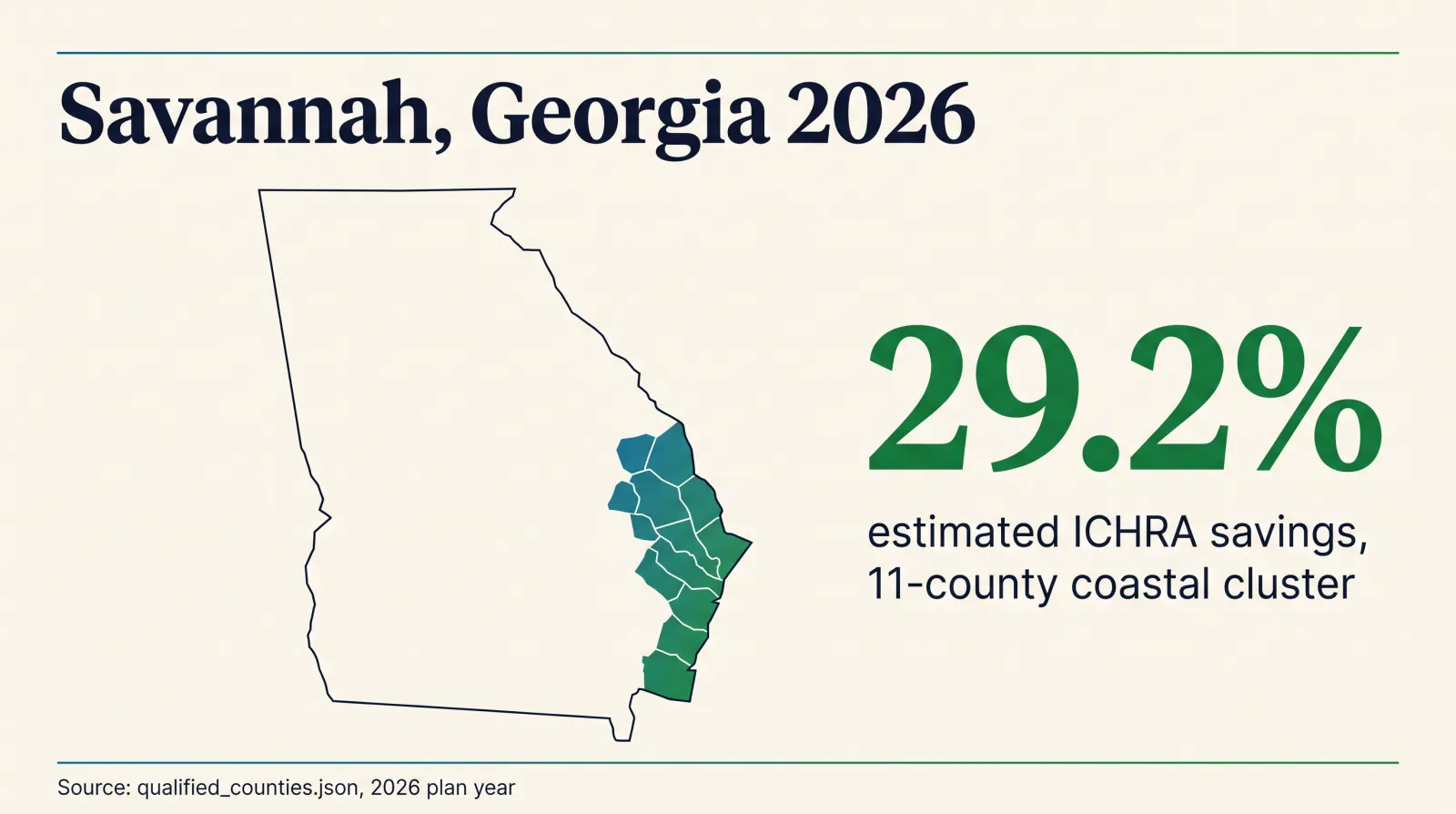
Chatham County's 2026 individual-market benchmark runs an estimated 29.2% below small group, about $1,984 per employee a year. See the Savannah data, sourced.
The short version
- Chatham County's 2026 individual-market benchmark runs an estimated 29.2% below the small-group benchmark, about $1,984 per employee per year.
- Chatham County holds 296,266 people, making this a large-population county with a genuine, if moderate, rate-spread advantage — below Georgia's own 41.8% average among qualifying counties, but backed by real scale.
- Only 130 of Georgia's 159 counties currently qualify. Chatham is one of them; metro Atlanta currently is not.
- Cigna is exiting the ACA individual exchange market nationally, including Georgia, at the end of 2026 — one fewer carrier for Savannah-area employees to choose from on the individual market.
- These are estimates from 2026 benchmark rate data, not quotes, and starting an ICHRA generally means an employee waives the premium tax credit for that month.
Does ICHRA beat small group in Savannah, Georgia?
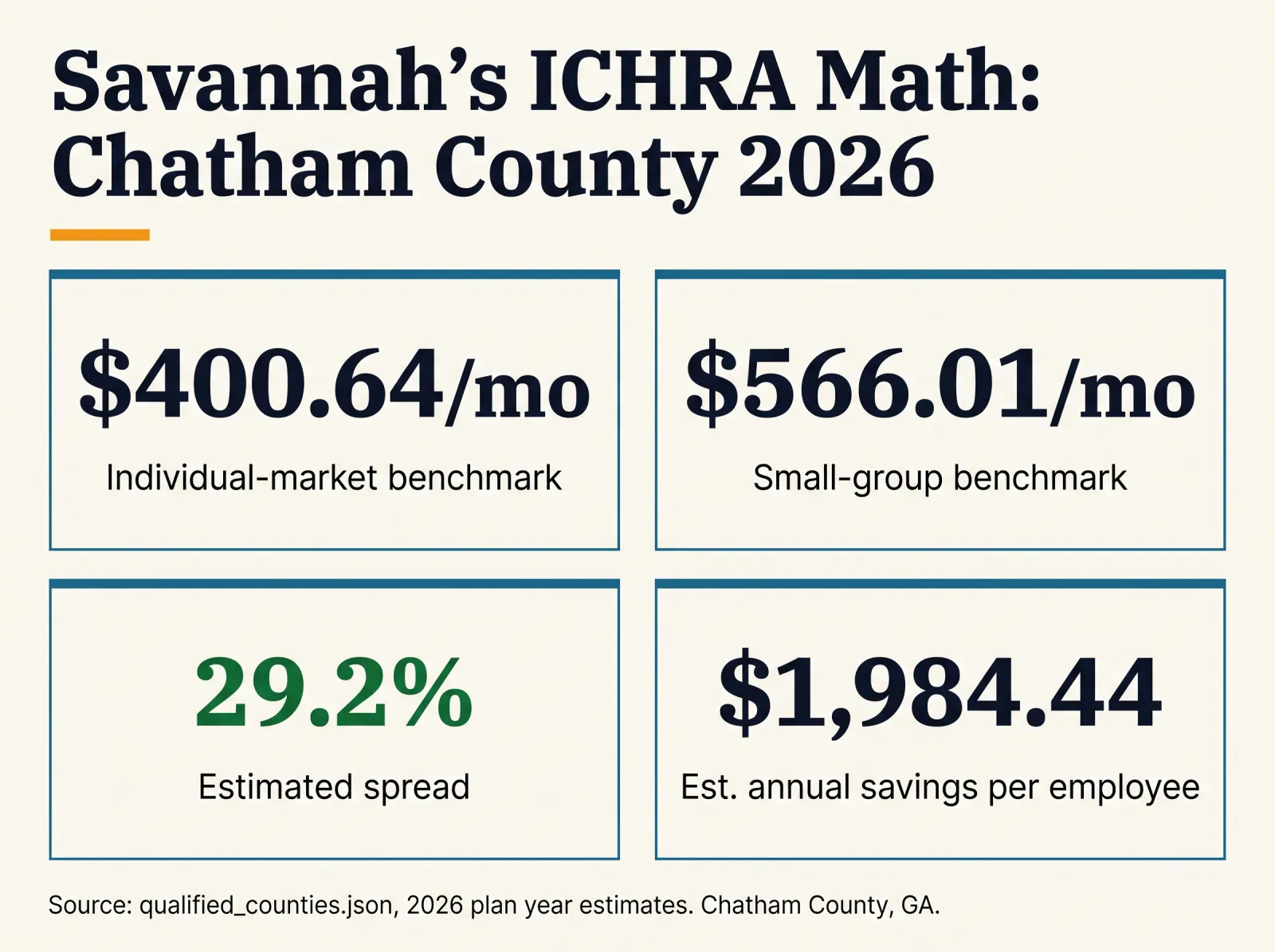
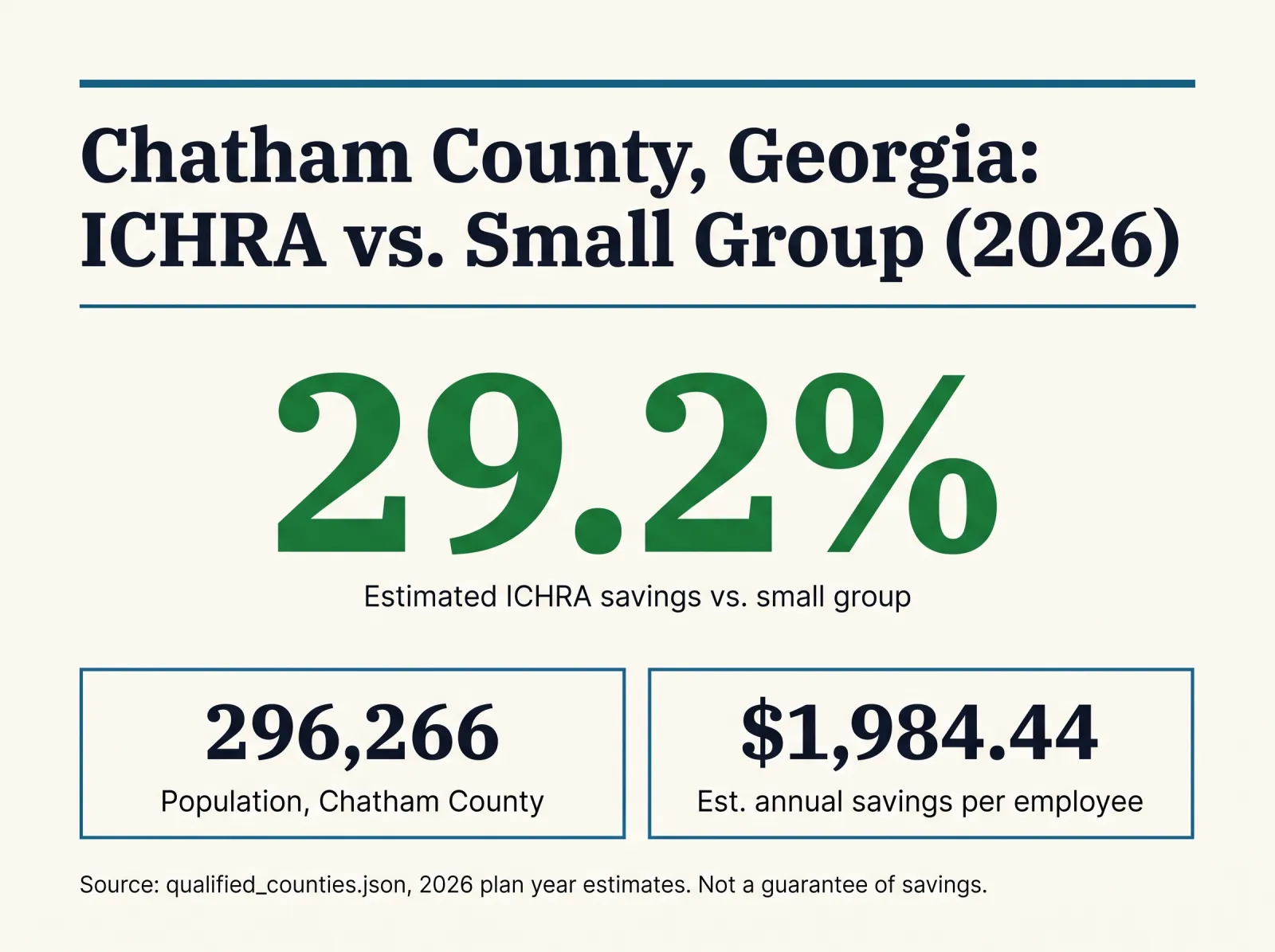
Yes, on the numbers behind this site's 2026 dataset. Chatham County, home to Savannah, shows an individual-market benchmark premium of $400.64 a month against a small-group benchmark of $566.01 a month — a spread of $165.37 a month, or an estimated 29.2% over the year. Run that out to $1,984.44 a year per employee, and that is before you account for whatever your 2026 small-group renewal actually did to your number.
Here is the detail worth sitting with: 29.2% is a genuinely useful spread, but it is not Georgia's highest. Some of the state's rural counties currently show estimated spreads above 50%. What makes Chatham County different is scale. Savannah is a real port and tourism economy with 296,266 people in the county alone, which means this spread applies to a large, dense working population rather than a handful of thousand residents in a thin rural county. A smaller percentage on a much bigger population base is often the more useful number for an employer actually trying to hire in this market.
Chatham County's rate spread
How the individual-market benchmark compares to the small-group benchmark for employees who actually live in Savannah and Chatham County.
Whether you offer anything today
Comparing ICHRA to "nothing" and comparing ICHRA to an existing small-group renewal are two different decisions with two different answers.
A market that's actively changing
A major national carrier is leaving the individual exchange market at the end of 2026, which affects what your employees will see when they shop.
The employers this is actually for
Two different Savannah-area employers read this article for two different reasons.
The first already offers small-group coverage and just opened a renewal letter with a number that does not match last year's budget. That employer wants to know whether switching converts an unpredictable annual shock into something they control, in a market where a major carrier is about to leave and the individual market is shifting under them either way.
The second employer offers nothing at all, usually because a full small-group plan felt out of reach for a 6- to 20-person company in Savannah's port, logistics, hospitality, or tourism economy, and the owner has been quietly worried about losing candidates to a competitor that offers even a modest benefit. That employer is not choosing between ICHRA and small group. They are choosing between ICHRA and nothing, and the arithmetic is completely different for that decision.
Why so many Savannah-area employers offer nothing
This is not a local quirk. It is the national pattern, and Chatham County's employer base — heavy on port logistics, hospitality, tourism, healthcare and small manufacturing — sits right in the size band where it shows up hardest. KFF's 2025 Employer Health Benefits Survey, published October 22, 2025, found that 59% of firms with 10 to 199 workers offer health benefits at all, compared with 97% of firms with 200 or more workers. Flip that small-firm number around: an estimated 41% of companies in that size band offer nothing, nationally, in 2025.
The reason is not that owners do not want to offer a benefit. It is that a traditional small-group plan usually asks for two things at once: a carrier-set participation minimum, often 70% or more of eligible employees enrolling, and a premium that is priced for the whole group regardless of how many people actually sign up. A 12-person restaurant group or logistics shop where several employees are already covered through a spouse's plan can fail that participation test before the price is even the issue. An ICHRA removes the participation requirement entirely, because each employee buys their own individual-market plan and the employer's only commitment is the reimbursement amount it sets, at whatever size that employer decides.
That is also why the HRA Council's adoption data, covered in more detail below, found that 83% of employers who started an ICHRA or QSEHRA in 2025 had never previously offered any coverage. The real competitor to ICHRA in a market like Savannah is not small group. It is nothing.
If that is where your company sits today, the mechanics of how the arrangement actually works are worth reading before you model a dollar amount: see how ICHRA works, step by step →
Chatham County's rate spread, in dollars
This figure is generated directly from this site's county dataset, not typed by hand. For Chatham County, the 2026 benchmark comparison is:
| County | Individual benchmark (mo.) | Small-group benchmark (mo.) | Estimated spread | Est. annual savings/employee | Population |
|---|---|---|---|---|---|
| Chatham (Savannah) | $401 | $566 | 29.2% | $1,984 | 296,266 |
Source: src/data/qualified_counties.json, 2026 plan year (Ideon rate data,
cross-verified against CMS public-use marketplace files). Estimates, not quotes; actual
results depend on your workforce.
29.2%
Chatham County's estimated 2026 spread
296,266
Chatham County population
130/159
Georgia counties currently qualifying
2026
Plan year in the dataset
Why Chatham qualifies and 29 other Georgia counties do not
Georgia is a large, geographically varied state, and its ICHRA picture is not uniform. Of the state's 159 counties, 130 currently show the individual-market benchmark pricing below the small-group benchmark, an average estimated spread of 41.8% among those qualifying counties, ranging from 25% in Pickens County up to 54.9% in Gordon County. The other 29 counties, including the core metro Atlanta counties, do not currently show that advantage.
Chatham County's 29.2% sits toward the lower half of Georgia's qualifying range, which is worth saying plainly rather than burying. It still clears the bar, and it applies to a large working population, but a Savannah employer should not assume every Georgia county an employee might live in prices the same way. A workforce that includes people commuting in from outside Chatham County needs each home county checked individually on the savings map, not assumed from this article's headline number.
Chatham County's estimated spread vs. Georgia's qualifying range
2026 plan year, individual-market benchmark vs. small-group benchmark premiums
Source: qualified_counties.json, 2026 plan year. Estimates, not quotes; not a
guarantee of savings for any specific employer.
The renewal backdrop: rates are rising, and a major carrier is leaving
Two separate forces are shaping what a Savannah-area employer will see at renewal, and it is worth being precise about which is which.
First, prices are moving nationally. The median proposed marketplace premium increase for 2026 was 18%, the highest in nearly a decade, according to the Peterson-KFF Health System Tracker, published August 6, 2025 and updated January 15, 2026 with approved rates. By the time the same research group published its analysis of 2027 filings on July 8, 2026, the national median proposed increase for 2027 stood at 14% across 77 insurers in 16 states and Washington, D.C. — lower than 2026, but a second straight year of double-digit proposed increases. Insurers point to underlying medical trend and, separately, to the expiration of enhanced premium tax credits at the end of 2025, which is expected to shrink and worsen the risk pool insurers price around. We were not able to confirm a single, consolidated Georgia-specific approved rate-increase figure from a state regulator source this session, the way some other states publish one; the fair statement for Georgia right now is the national trend above, applied to a market that is simultaneously losing a carrier, covered next.
Second, carrier participation is shrinking. The Cigna Group announced on its first-quarter 2026 earnings call, on April 30, 2026, that it will exit the ACA individual exchange market at the end of 2026, affecting an estimated 369,000 members across 11 states, including Georgia. Cigna is not the only recent exit from the individual market nationally. Fewer competing carriers in a market generally means less competitive pressure on price and fewer plan options for an employee shopping the individual market with an ICHRA allowance, which is a real factor for a Savannah employer to weigh, separate from the rate-spread math in the tables above.
How an ICHRA actually works, mechanically
An Individual Coverage HRA, or ICHRA, is a federal HRA structure created by a 2020 final rule from the IRS, the Department of Labor and HHS. It lets an employer of any size, including a single employee, set a fixed monthly reimbursement amount instead of buying a group insurance policy. Employees use that allowance to buy their own individual-market plan — on the ACA marketplace or off it — and submit proof of coverage, called substantiation, to get reimbursed tax-free.
An employee class is a permitted way of grouping employees (full-time versus part-time, salaried versus hourly, or by geographic rating area, among others) so an employer can offer different ICHRA terms to different classes. The affordability test is the calculation that decides whether a given ICHRA contribution counts as "affordable" under IRS rules for a specific employee, which in turn decides whether that employee keeps eligibility for a premium tax credit. None of these are Georgia-specific; they apply the same way in every state.
The mechanism behind the savings shown above is simple to state: in Chatham County, the benchmark individual-market plan currently costs less per month than the benchmark small-group plan. An employer who sets an ICHRA contribution near the individual benchmark is funding real coverage at a lower monthly cost than the small-group alternative, for that specific county, for that specific plan year. It is a rate-spread effect, not a discount or a subsidy the employer is somehow accessing. If the spread narrows or reverses when carriers refile for 2027, so does the savings case, which is exactly why every county figure on this site carries a year and a source.
A worked example for a Savannah employer
The arithmetic below uses the Chatham County benchmark figures from the table above. It is illustrative, not a projection for any specific business, and is built purely to show how the math works.
Example: an 18-person Savannah hospitality or logistics company that offers nothing today
Funding each employee at the Chatham County individual benchmark of $400.64 a month costs 18 × $400.64 × 12 months = $86,538.24 a year, or $4,807.68 per employee. Setting up small-group coverage at the same county's benchmark of $566.01 a month would cost 18 × $566.01 × 12 months = $122,338.16 a year. The gap, roughly $35,800 a year in this illustrative comparison, is the same $1,984.44-per-employee figure from the table above, scaled to 18 people. For a company offering no benefit at all today, the ICHRA side of that comparison is the one worth pricing against your actual hiring budget.
This example is not a promise about what your renewal, your workforce, or your actual carrier quote will show. It uses this site's benchmark figures to demonstrate the mechanics, not to forecast your bill.
How ICHRA adoption is actually growing
ICHRA is not a niche product anymore. The HRA Council's "Growth Trends for ICHRA & QSEHRA 2024-2025" report, based on anonymized data voluntarily shared by fifteen member organizations through January 2025, found that small, non-ALE ICHRA adoption grew 52% year over year among founding members, while aggregate large-employer (ALE) adoption grew 34%, with some large-employer cohorts up 49%. The same report found that 83% of employers who started an ICHRA or QSEHRA in 2025 had never previously offered any coverage — we found that figure in only that one report, so we are stating it plainly rather than implying it is independently confirmed elsewhere.
That growth curve lines up with what Savannah's employer base actually looks like. The port, logistics, tourism and hospitality sectors that anchor Chatham County's economy skew toward smaller companies and toward seasonal or hourly staffing, exactly the profile where, per the KFF figures above, more than four in ten firms currently offer no health benefit at all.
52%
YoY growth, small/non-ALE ICHRA adoption (HRA Council founding members)
34%
YoY growth, aggregate large-employer (ALE) adoption
83%
2025 ICHRA/QSEHRA employers with no prior coverage offered
Offering nothing, or renewing small group
- Either no benefit at all, or a renewal number set by the carrier
- Participation minimums can block a plan before price is even the issue
- Fewer carriers competing for individual-market business as Cigna exits
- Shopping the market every year, if you have a plan to shop
VariableOr zero
Running an ICHRA in Chatham County
- Cost is the contribution you choose, informed by the Chatham County benchmark
- No carrier participation minimum to hit
- Each employee shops the individual market directly, wherever they live
- Reimbursement workflow replaces annual renewal shopping
FixedBudget set by you
Setting up an ICHRA in Savannah
The rules are federal, so a Savannah-based rollout follows the same sequence as anywhere else in the country. The order matters more than most employers expect.
- Pull your census by county. Not by headquarters address — by where each employee actually lives, since not every Georgia county prices the same way.
- Check the spread for every county your team lives in. The table above covers Chatham County; the savings map covers the rest of Georgia.
- Model affordability before setting a contribution amount. The reimbursement level decides whether each employee keeps premium tax credit eligibility.
- Define employee classes carefully, if you use them. Class rules have minimum-size requirements and hard constraints under the federal rule.
- Send the required advance employee notice on time. Late notice creates real compliance problems, not just an awkward conversation.
- Budget for onboarding support. Employees who have never shopped the individual market need guidance once, not ongoing hand-holding, especially with carrier participation shifting.
Run the county check first
Before anything else, check whether your specific Georgia counties are ones where this works. Ten minutes on the savings map tells you whether the rest of this process is worth starting: Check your county on the savings map →
The honest limits of this data
Qualifying in Chatham County is not a guarantee for your business
- 29.2% is below Georgia's own average. Some rural Georgia counties currently show a larger percentage spread; Chatham's case rests more on population scale than on having the state's best number.
- A benchmark comparison is not your actual renewal. The $566.01 Chatham County figure is a small-group benchmark built from filed rates, not your carrier's specific quote for your specific group.
- Older or higher-risk workforces change the math. Individual-market premiums are age-rated more steeply in some rating areas than small-group premiums, which can narrow real-world savings for an older team.
- Rates and carrier participation move every plan year. With Cigna exiting the individual exchange market at the end of 2026 and national rates still climbing, this comparison could shift for 2027; recheck before every renewal, not just once.
- Taking an ICHRA generally means waiving the premium tax credit for that month. For an employee close to the 400% FPL subsidy cliff, that trade-off deserves its own conversation before enrollment — see our ACA subsidy cliff guide for the income thresholds by household size.
Chatham County does not have Georgia's best percentage. It has a real, sourced spread on a large working population, which is often the more useful combination — and the only way to know if that holds for your own workforce is to check.
Mike MooreHow these numbers are calculated
Every county figure in this article comes from the same dataset that powers our savings map, not a survey or a sales estimate. For Chatham County, we compare a 2026 individual-market benchmark premium — the second-lowest-cost silver plan available to a representative enrollee, the same benchmark the federal government uses to calculate premium tax credits — against a small-group benchmark premium built from comparable small-group plan filings for that rating area. Both figures come from Ideon, a licensed insurance rate-data provider, and are cross-verified against CMS public-use marketplace files before publication. A county "qualifies" when the individual benchmark sits below the small-group benchmark; the percentage and dollar figures in this article are the gap between those two numbers, expressed as an annual per-employee figure at 12 times the monthly difference.
The national rate-trend figures (18% and 14% median proposed increases) and the KFF Employer Health Benefits Survey figures (59% and 97%) come from separately published, externally sourced analyses — the Peterson-KFF Health System Tracker and KFF — not from our own county dataset, and they describe national marketplace rate trends and employer survey results, not the benchmark premiums used in the county comparison above. The Cigna exit announcement comes from Cigna's own April 30, 2026 earnings call, as reported by STAT News. We have kept these sources clearly separate throughout this article rather than blending them into one number, and we were not able to confirm a single consolidated Georgia-specific approved rate-increase figure from a state regulator source this session, which is why none appears above.
Three limitations are worth stating plainly. First, benchmark premiums are built around a representative enrollee profile, so an unusually young or unusually old workforce will see a different real-world spread than the county figure implies. Second, these are benchmark plans, not every plan on the market; an employee who chooses a richer or leaner plan than the benchmark will see a different premium, though the relative spread tends to hold directionally. Third, rates are filed and refreshed annually, so a county that qualifies for 2026 is not guaranteed to qualify for 2027 if a carrier enters or exits that market — which, with Cigna's planned exit, is already in motion.
Questions Savannah employers actually ask
Does ICHRA beat small-group insurance in Savannah, Georgia?
Yes, on the current 2026 benchmark comparison. In Chatham County, the county that contains Savannah, the individual-market benchmark premium runs an estimated 29.2% below the small-group benchmark, about $1,984 per employee per year. That is an estimate built from public and industry rate data, not a quote, and your actual result depends on your employees’ ages and the plans they choose.
Is 29.2% a good number, compared to the rest of Georgia?
It is a real, usable spread, but it sits below Georgia's own statewide average of an estimated 41.8% among the state's qualifying counties. Some rural Georgia counties currently show spreads above 50%. Chatham's advantage is that it combines a genuine savings case with a large, dense population base (296,266 people), rather than the highest percentage in the state.
Does every county in Georgia qualify for ICHRA savings?
No. As of the current 2026 dataset, 130 of Georgia's 159 counties price the individual-market benchmark below the small-group benchmark, meaning 29 counties currently do not show this same advantage. Metro Atlanta, notably, is not part of the current qualifying list. Chatham County is one of the 130 that does.
Is Chatham County’s health insurance market changing?
Yes. The Cigna Group announced on April 30, 2026 that it will exit the ACA individual exchange market nationally, including Georgia, at the end of 2026, affecting an estimated 369,000 members across 11 states. Fewer carriers competing for individual-market enrollees is a genuine factor for any Savannah-area employer weighing ICHRA against small group, since it can affect the plan choices your employees see when they shop the individual market.
Why did my 2026 small-group renewal come in so high?
It is a national pattern, not just a Savannah issue. The median proposed marketplace premium increase for 2026 was 18% nationally, the highest in nearly a decade, according to the Peterson-KFF Health System Tracker. Insurers cite rising medical and prescription-drug trend, labor costs, and a shrinking, higher-risk enrollment pool as the primary drivers, with the expiration of enhanced federal premium tax credits compounding the effect heading into 2027.
We have never offered any health benefit. Is ICHRA realistic for a small Savannah company?
It is one of the more realistic entry points. Nationally, 59% of firms with 10 to 199 workers offer health benefits at all, per KFF’s 2025 Employer Health Benefits Survey, and the HRA Council found that 83% of employers who started an ICHRA or QSEHRA in 2025 had never previously offered coverage. An ICHRA lets you set a monthly contribution of any size and stop there — there is no participation minimum and no requirement to match a carrier’s plan menu.
Does Georgia impose any state-specific ICHRA rules?
No. ICHRA is a federal HRA structure created by a 2020 final rule from the IRS, the Department of Labor and HHS, and it works the same way in Georgia as in any other state. The Georgia Office of Insurance and Safety Fire Commissioner reviews carrier rate filings for the individual and small-group markets, but it does not add ICHRA-specific requirements on top of the federal rule.
What happens to my employees' premium tax credit if we start an ICHRA?
An employee who is offered an affordable ICHRA generally becomes ineligible for a premium tax credit for any month that offer applies, whether or not they accept it. That trade-off matters more with the 400% FPL subsidy cliff back for 2026 coverage. Our separate guide on the ACA subsidy cliff walks through the income thresholds by household size.
Where can I check the numbers for my specific Georgia county?
Use the savings map to look up any Georgia county by name. It shows the 2026 individual-market and small-group benchmark premiums side by side, so you can see the estimated spread, or the lack of one, before modeling a rollout for your own workforce.
Sources
- Peterson-KFF Health System Tracker, "How Much and Why ACA Marketplace Premiums Are Going Up in 2026" (Aug. 6, 2025; updated Jan. 15, 2026)
- Peterson-KFF Health System Tracker, "How Much and Why ACA Marketplace Premiums Are Going Up in 2027" (Jul. 8, 2026)
- STAT News, "Cigna to exit ACA market, 369,000 people affected" (Apr. 30, 2026)
- KFF, "2025 Employer Health Benefits Survey" (Oct. 22, 2025)
- HRA Council, "Growth Trends for ICHRA & QSEHRA, Vol. 4" (data through Jan. 2025)
- ICHRA final rule: Departments of the Treasury/IRS, Labor, and Health and Human Services (2020)
- County-level premium comparison:
src/data/qualified_counties.json, 2026 plan year (Ideon rate data, cross-verified against CMS public-use marketplace files)