ICHRA in Virginia 2026: Richmond Wins, Fairfax Loses
Virginia small-group rates rose 11.2% for 2026. See which of Virginia's 133 counties and cities an ICHRA estimate beats small group, and which do not.
The short version
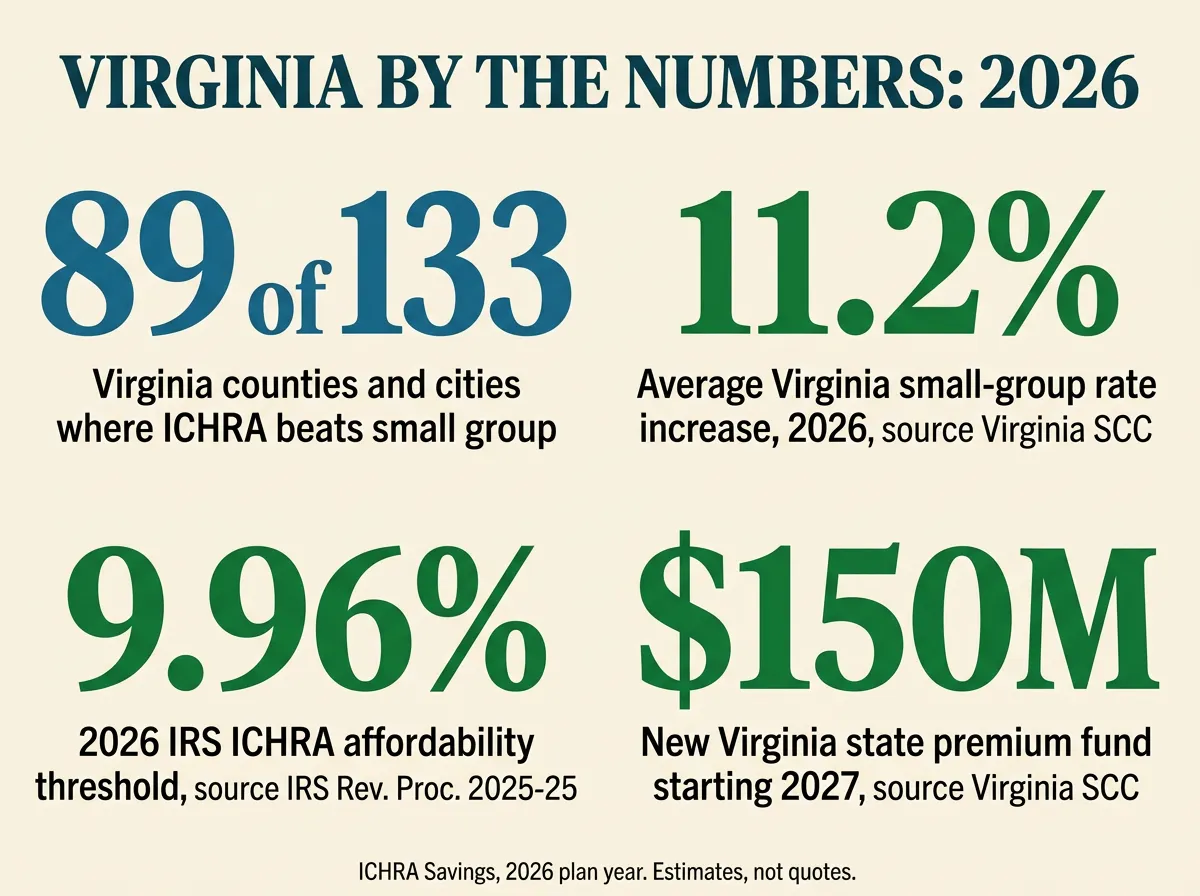
- ICHRA beats small-group coverage in 89 of Virginia's 133 counties and independent cities for 2026, about 67% of the Commonwealth and 12% of the national 719-locality total.
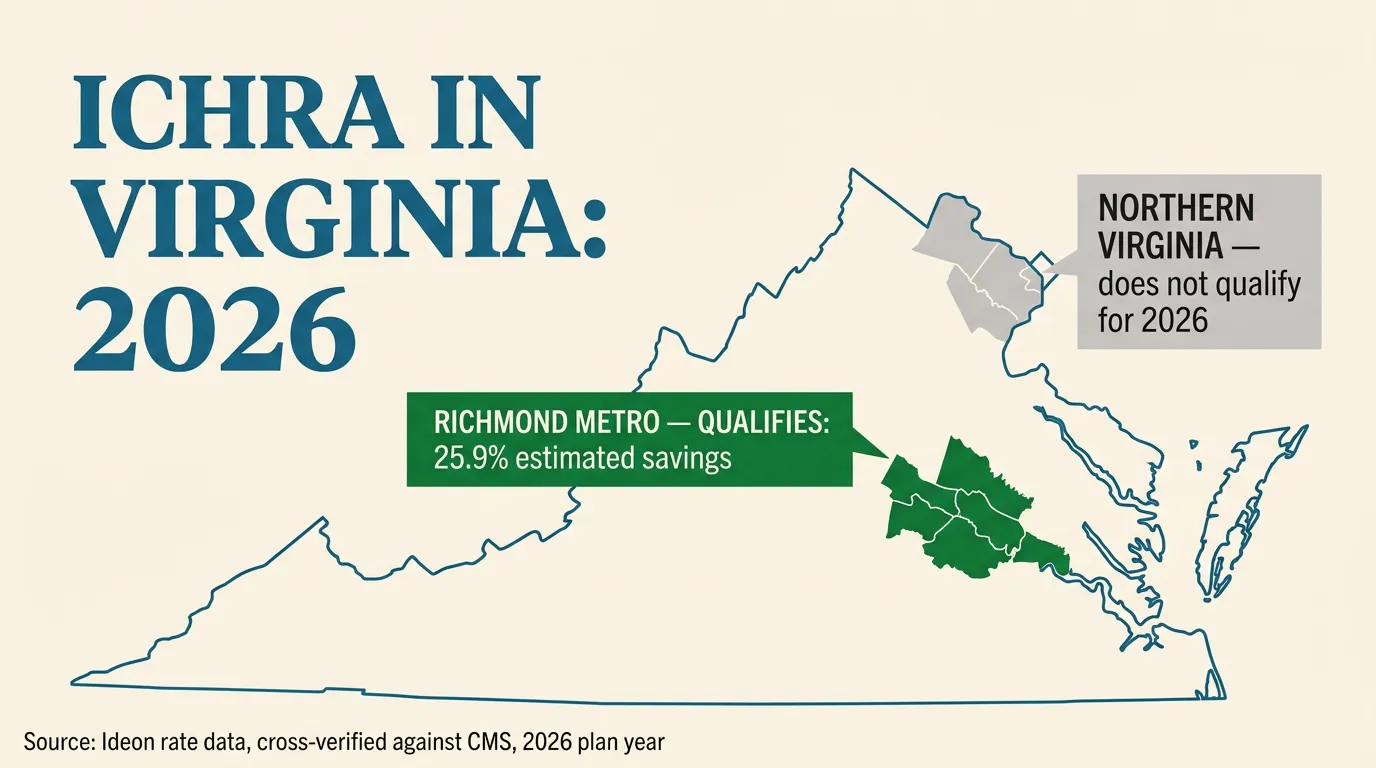
- Richmond city, Henrico County and Chesterfield County qualify at an estimated 25.9% savings. Fairfax, Arlington, Loudoun, Prince William and every Hampton Roads locality currently do not.
- Virginia's small-group market rose an average of 11.2% for 2026, and most individual-market insurers filed increases of 20% or higher, according to the State Corporation Commission.
- A new $150 million state fund starts helping some individual-market shoppers in the 2027 plan year — useful context for employees, but it does not change how an employer sets up an ICHRA.
Does ICHRA beat small group in Virginia?
Yes, in specific parts of the state. An ICHRA (Individual Coverage Health Reimbursement Arrangement) currently beats traditional small-group coverage in 89 of Virginia's 133 counties and independent cities for the 2026 plan year, based on a locality-by-locality comparison of individual-market and small-group benchmark premiums built from Ideon rate data and cross-verified against CMS public-use marketplace files. Virginia is one of only 18 states in our national dataset where any locality qualifies at all, and its 89 qualifying localities make up about 12% of the 719 counties and cities nationwide where the math currently favors ICHRA.
If you haven't worked through the general decision yet, our ICHRA vs. small group decision guide walks through the framework this article applies specifically to Virginia. The honest caveat first, because it's the one thing most "ICHRA is great in Virginia" content skips: the 89 qualifying localities do not include the state's biggest population centers. If your company is headquartered in Tysons, Reston, Alexandria, Virginia Beach or Norfolk, the county-level math does not currently favor an ICHRA over small group. If your workforce sits in or around Richmond, the Roanoke Valley, Blacksburg or a wide swath of rural and small-metro Virginia, it very likely does. That split, not a single statewide number, is the actual story, and we walk through exactly why later in this guide.
89
Virginia counties and cities where ICHRA beats small group in 2026
67%
Share of Virginia's 133 counties and independent cities that qualify
3.2M
Virginians living in a qualifying locality
$1,049
Average estimated savings per employee, per year
Why Virginia renewals spiked for 2026
If you run a small business in Virginia and your 2026 renewal came in higher than you budgeted, you are not imagining it. According to the Virginia State Corporation Commission's Bureau of Insurance, most of the state's 10 individual-market insurers proposed average rate increases of 20% or higher for 2026, and the small-group market rose an average of 11.2%. The Bureau's own summary points to the same three drivers showing up across the country: the elimination of enhanced federal premium tax credits, ongoing market uncertainty, and rising hospital and pharmacy costs and utilization.
One piece of good news buried in that filing: Virginia's Commonwealth Health Reinsurance Program, running since 2023 under the state's federal Section 1332 waiver, is keeping individual-market rates an estimated 15% or more below what they would be without it. Reinsurance works by having the state reimburse insurers directly for a share of their highest-cost claims, the small number of enrollees whose treatment runs into six figures a year, so insurers don't have to price that risk entirely into everyone else's premium. Several 2026 carrier filings, including CareFirst BlueChoice's and GHMSI's, cite "a higher projected reinsurance factor" as one of their rate-change drivers, meaning the program's effect shows up directly in the numbers insurers filed. Reinsurance blunts the increase; it does not reverse it. An 11.2% small-group renewal on top of several years of prior increases is exactly the kind of number that sends a Virginia office manager searching for alternatives, and it's the practical reason ICHRA conversations are happening in HR offices across the state right now.
| Metric | Virginia, 2026 | Detail |
|---|---|---|
| Individual-market rate change | Most of 10 insurers proposed 20%+ increases | 2026 plan year |
| Small-group rate change | Average +11.2% increase | 2026 plan year |
| Reinsurance program effect | Keeps individual rates 15%+ below what they would otherwise be | Since 2023 |
| IRS affordability threshold | 9.96% of household income | 2026 plan year, national |
Why this matters to an employer, not just an individual
A rising small-group renewal is a fixed cost that keeps moving whether or not your headcount or your claims experience changes. An ICHRA does not make Virginia's underlying medical costs go away, but it replaces an unpredictable annual renewal number with a monthly contribution the employer sets and controls.
Virginia's 2026 rate filings, carrier by carrier
The 20%-plus individual-market figure and the 11.2% small-group average are Bureau of Insurance summary numbers. The underlying carrier filings, each a public document reviewed and approved by the Bureau, show why those averages land where they do and how much they vary by insurer. Ten carriers filed 2026 individual-market rates in Virginia, the same count the Bureau cited in its summary release.
| Carrier | Approved average change | Range by plan |
|---|---|---|
| Optimum Choice (UnitedHealthcare) | 35.4% | Range 33.6%–43.1% |
| Cigna Health & Life | 22.8% | Range 19.4%–25.4% |
| Sentara Health Plans | 22.4% | Range 14.3%–55.8% |
| HealthKeepers (Anthem) | 20.9% | Range 18.1%–28.9% |
| Sentara Health Insurance Co. | 20.1% | Range 19.5%–43.4% |
| Anthem Health Plans of VA | 23.1% | Range 20.9%–23.4% |
| CareFirst BlueChoice | 18.2% | Range 6.4%–44.9% |
| Kaiser (Mid-Atlantic) | 11.8% | Range 7.5%–30.6% |
| Oscar Insurance | 3.0% | Range 0.5%–5.2% |
| Group Hospitalization & Medical Services | 1.1% | Range −6.0%–1.6% |
Seven of the ten individual-market carriers landed at 18% or higher. Every filing that explains its drivers names the same primary cause first: the expiration of enhanced federal premium tax credits at the end of 2025, which insurers expect to shrink and sicken their remaining risk pool as healthier members who relied on the subsidy leave the market. Optimum Choice's filing, the highest in the state at 35.4%, attributes 21.8 percentage points of its increase to "Other," driven mainly by the subsidy expiration's effect on enrollment and morbidity. Kaiser's 11.8% sits well below the pack in part because Kaiser is also cutting its margin, from a positive contribution to reserve down to −8.1%, effectively subsidizing its own members rather than passing the full cost increase through.
| Carrier | Approved average change | Range by plan |
|---|---|---|
| UnitedHealthcare Plan of the River Valley | 12.5% | Range 8.5%–16.5% |
| Sentara Health Plans | 11.9% | Range 8.5%–14.9% |
| Sentara Health Insurance Co. | 11.9% | Range 9.4%–13.8% |
| UnitedHealthcare of the Mid-Atlantic | 9.1% | Range 7.9%–10.3% |
| Optimum Choice (UnitedHealthcare) | 8.9% | Range 5.5%–10.4% |
| Kaiser (Mid-Atlantic) | 8.1% | Range 3.2%–17.6% |
| UnitedHealthcare Insurance Co. | 8.1% | Range 5.4%–10.3% |
| HealthKeepers (Anthem) | 15.6% | Range 14.0%–18.1% |
| Anthem Health Plans of VA | 15.6% | Range 14.1%–16.1% |
| Group Hospitalization & Medical Services | 2.15% | Range −0.2%–3.0% |
| CareFirst BlueChoice | 1.4% | Range −2.0%–3.1% |
The small-group spread tells a different story than the individual market. Anthem's two Virginia entities, HealthKeepers and Anthem Health Plans of Virginia, both filed 15.6% small-group increases and together cover well over 100,000 Virginia small-group members, the largest block in the state, which is a big part of why the statewide 11.2% average sits well above the simple average of every filed rate. CareFirst BlueChoice, by contrast, filed a small-group increase of just 1.4%, citing favorable claims experience. A small employer's actual renewal depends heavily on which of these carriers underwrites their current plan, which is exactly the kind of variation a single statewide percentage cannot capture — and exactly why an employer comparing a specific renewal notice against an ICHRA needs their own county-level and carrier-level numbers, not a state average.
The 89 counties and cities where ICHRA wins
Virginia's qualifying localities cluster around two metro corridors and a wide band of rural counties: the Richmond metro (Richmond city, Henrico, Chesterfield, and the smaller counties ringing them), the Roanoke Valley and New River Valley (Roanoke city, Roanoke County, Montgomery County), and most of Southside and Southwest Virginia, from Amelia and Dinwiddie in the east to Lee and Wise Counties near the Kentucky and Tennessee borders. Savings run from about 20.7% to 25.9% below the small-group benchmark, a narrower band than some states post, but a consistent one across a large share of the Commonwealth's land area.
| County or city | Population | Savings vs. small group | Est. annual savings / employee |
|---|---|---|---|
| Chesterfield County | 366,019 | 25.9% | $1,167 |
| Henrico County | 333,120 | 25.9% | $1,167 |
| Richmond city | 227,171 | 25.9% | $1,167 |
| Montgomery County | 99,373 | 22.3% | $1,079 |
| Roanoke city | 99,213 | 22.3% | $1,079 |
| Roanoke County | 96,653 | 22.3% | $1,079 |
| Frederick County | 92,007 | 20.8% | $982 |
| Bedford County | 79,761 | 20.7% | $914 |
| Lynchburg city | 79,166 | 20.7% | $914 |
| Augusta County | 77,433 | 21.3% | $1,017 |
The single highest percentage figure in the state, 25.9%, is shared by a wide group of central Virginia localities that includes Richmond city itself along with Henrico, Chesterfield, Amelia, Charles City, Cumberland, Dinwiddie, Goochland, King and Queen, King William, New Kent, Powhatan, Prince George and Sussex Counties, plus the independent cities of Colonial Heights and Hopewell. The Roanoke Valley and Montgomery County sit a step below at 22.3%, and the lower end of the qualifying band, around 20.7%, shows up in Southside and central-west localities such as Lynchburg city, Bedford, Campbell, Amherst and Appomattox Counties. These are estimates from public rate data, not quotes, and they will move as carriers file new 2027 rates.
How Virginia's 89 qualifying localities break down by savings tier
Number of counties and independent cities in each savings band, 2026 plan year. Source: Ideon rate data, cross-verified against CMS public-use files.
No qualifying Virginia locality currently exceeds 26% savings. Illustrative and rounded; not an offer of insurance or a guarantee of savings.
See the full Virginia savings breakdown for every qualifying county and city, or the national savings map to check a specific locality by name.
Why Northern Virginia and Hampton Roads aren't on the list
Not one locality in Northern Virginia — not Fairfax, Arlington, Loudoun, Prince William, or Alexandria — currently qualifies. Neither does any locality in Hampton Roads: Virginia Beach, Chesapeake, Norfolk, Newport News, Hampton, Suffolk and Portsmouth are all off the list, as are the Fredericksburg-area localities of Stafford, Spotsylvania and Fredericksburg city, and the Williamsburg-area localities of James City and York Counties. Charlottesville and Albemarle County, despite sitting only about 70 miles from qualifying Richmond-area localities, don't qualify either.
This is not a data gap. It reflects the same mechanical pattern that shows up in every state we've mapped: a locality's individual-market and small-group benchmark premiums land close together, or the individual benchmark lands above small group, when that market has more competing options and buying power holding prices down relative to the small-group side. Northern Virginia's individual market sits inside one of the country's largest concentrations of federal employment and federal contracting, both of which lean heavily on employer-sponsored group coverage; Hampton Roads carries a comparably large concentration of military and federal-adjacent employment. Neither dynamic makes ICHRA a bad idea for an employer in those regions. It means that, for the specific 2026 rate filings behind this dataset, the individual-versus-small-group spread there hasn't opened up the way it has in Richmond, Roanoke, or rural Southside and Southwest Virginia.
The Bureau of Insurance itself divides Virginia into 12 ACA rating areas, the geographic zones carriers use to set different base premiums within the same state: Blacksburg, Charlottesville, Danville, Harrisonburg, Bristol, Lynchburg, Richmond, Roanoke, Tidewater (Hampton Roads), Northern Virginia, Winchester, and a catch-all Non-MSA area for the rest of the state. Every carrier's rate filing sets a separate area factor for each zone it sells in, and those factors are public. They explain relative pricing within one insurer's book of business, not the individual-versus-small-group spread this dataset tracks, but they confirm that Virginia's insurance regulators treat Richmond, Roanoke, Northern Virginia and Tidewater as genuinely distinct markets, not one statewide market with a single price. That is the same logic behind checking your own locality on the savings map instead of trusting a state or even a regional average.
For an employer headquartered in one of these non-qualifying metros, the practical takeaway isn't "ICHRA doesn't work for us." It's "check every locality your workforce actually lives in, not just your headquarters address." A professional-services firm based in Arlington with remote staff in Roanoke or Lynchburg already has part of its workforce inside a qualifying locality today. And because carriers file new rates every plan year, a Northern Virginia or Hampton Roads locality entering the qualifying list for 2027 is a realistic scenario worth rechecking at the next renewal, not a permanent no.
ICHRA isn't better than small group in Virginia. It's better in 89 specific counties and cities, and Fairfax, Arlington and the whole of Hampton Roads currently aren't among them.
Mike Moore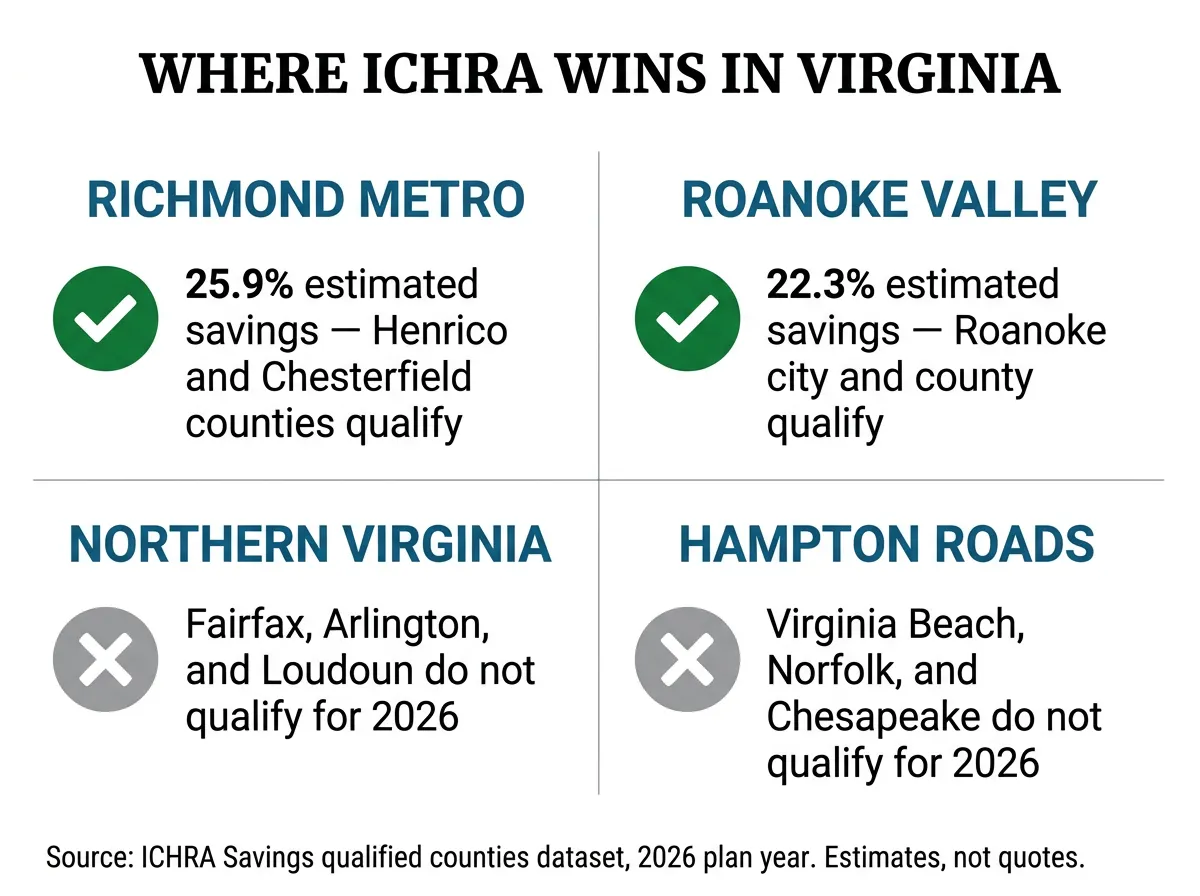
A worked example: Richmond versus Fairfax
Here's what the locality-level math actually looks like for a small employer with a split Virginia workforce, using real 2026 rate data for a qualifying locality and a non-qualifying one. Assume a 20-employee company with 12 employees in Henrico County (Richmond metro, qualifying) and 8 employees in Fairfax County (Northern Virginia, not currently qualifying).
Here's the math
In Henrico County, the 2026 individual-market benchmark premium is $278.00/month against a small-group benchmark of $375.26/month — a savings of $97.26/month, or $1,167.12 a year per employee. In Fairfax County, the individual-market benchmark currently sits at or above the small-group benchmark, so the ICHRA math does not clear the bar there for 2026 using benchmark figures.
For this hypothetical 20-person company: 12 employees × $1,167.12 (Henrico) = an estimated $14,005 a year in aggregate savings on the Richmond-metro half of the workforce alone, using benchmark-level ICHRA contributions, with the Fairfax-based employees requiring a separate conversation about whether small group, a different ICHRA contribution strategy, or another benefit approach fits best. This is an illustrative estimate using real locality rate data and a hypothetical headcount split — your actual result depends on your employees' ages, exact localities, and the plan levels they choose.
Notice what this example does not do: claim a single statewide "Virginia saves X%" figure. A headline like that would hide the fact that Henrico's math clears easily while Fairfax's, as of this dataset, doesn't clear at all. That is the entire argument for checking localities individually rather than trusting a state average — and it is more true in Virginia than in almost any other state we've mapped, because the gap between its best-performing and worst-performing metros is so wide.
Scale the same math to a bigger, more realistic Virginia employer. A 50-person Richmond-area firm with staff spread across Henrico, Chesterfield and the city of Richmond, all qualifying at 25.9%, could see an estimated $58,356 a year in aggregate savings if it funded ICHRA contributions at the benchmark level across the board (50 × $1,167.12). That is not a guarantee. It assumes every employee enrolls in a plan priced near the benchmark, and real households will land above or below it depending on age, plan choice and household size. It is, however, a real number built from real 2026 rate filings, which is more than most "switch to ICHRA and save" marketing offers.
Virginia's new $150 million premium fund
Separately from the ICHRA math, Virginia's General Assembly created a new state-funded subsidy program, the Health Insurance Affordability Fund, in response to the 2026 rate increases and the loss of enhanced federal premium tax credits. According to the State Corporation Commission, roughly 100,000 Virginians lost marketplace coverage during 2026 as costs rose, and the new fund is aimed at helping bring some of them back starting with the 2027 plan year.
| Detail | Figure |
|---|---|
| Total funding | $150 million |
| Income eligibility | 138%–250% of the federal poverty level |
| Estimated eligible enrollees | ~200,000 Virginians |
| Maximum premium savings | Up to 70% |
| Coverage year | 2027 plan year, enrollment opens Nov. 1, 2026 |
The fund is aimed at individuals shopping the marketplace directly, with household income between 138% and 250% of the federal poverty level. For a household of one, that band runs roughly from Virginia's Medicaid-adjacent income floor up to about $39,125 (250% of the 2025 federal poverty guideline of $15,650); for a household of four, roughly up to about $80,375 (250% of $32,150). An employee using an ICHRA contribution to buy an individual plan can potentially combine that contribution with this new state assistance if their income and plan qualify, the same way they could already combine an ICHRA with a federal premium tax credit when the ICHRA is deemed unaffordable under the IRS test. The fund itself changes nothing about how an employer designs or funds an ICHRA; it's context worth knowing when you're explaining the shift to employees, especially anyone who lost subsidized coverage earlier in 2026.
Here's the math on affordability
Take a Henrico County employee earning $45,000 a year. Under the 2026 Required Contribution Percentage of 9.96%, their household's contribution toward the lowest-cost silver plan (LCSP) in their rating area is considered affordable if it does not exceed $373.50 a month (9.96% of $45,000, divided by 12). If Henrico's 2026 individual-market benchmark premium is $278.00 a month and the employer's ICHRA contribution covers, say, $200 of it, the employee's remaining share is $78.00 a month, well under the $373.50 affordability line. That ICHRA is affordable for this employee, which means they must waive the premium tax credit to use it. If the same employer had set a smaller contribution, say $50 a month, leaving the employee with a $228 monthly share, the ICHRA would still clear the affordability line here, since $228 is still under $373.50. The math changes fast for lower-income employees or thinner contributions, which is why modeling this test for your actual census, not a rule of thumb, has to happen before you set a contribution amount.
Say this plainly to employees
Taking an employer's ICHRA contribution generally means an employee waives the federal premium tax credit for that month, unless the ICHRA is unaffordable under the IRS test, in which case they can decline it and keep shopping the marketplace with a subsidy instead. Virginia's new state fund does not change this federal rule. Anyone modeling their own numbers needs to understand which side of that line they're on before they decide.
How ICHRA adoption is actually growing
Virginia's numbers sit inside a national adoption trend that is compounding, not plateauing. The HRA Council's most recent annual report, Growth Trends for ICHRA & QSEHRA, Vol. 4 (aggregating anonymized 2024–2025 enrollment data from 15 member organizations), found that small, non-ALE ICHRA adoption grew 52% year over year among its founding members, while adoption among large employers grew 34% overall, with some large-employer cohorts posting 49% growth.
The number that matters most for a Virginia employer weighing this for the first time: 83% of employers offering ICHRA or QSEHRA in 2025 had never previously offered any group coverage at all, while only 17% switched over from a traditional group plan. For most small Virginia businesses in the 89 qualifying localities, the realistic comparison isn't "ICHRA versus our current group plan" — it's "ICHRA versus offering nothing," which is a much easier case to make when you're competing for talent against employers who already offer some kind of benefit.
That distinction matters more in Virginia's tighter labor markets outside the big metros. A 20-person manufacturer in Pittsylvania County or a professional-services firm in the Roanoke Valley is not competing for talent against Northern Virginia's federal-contractor salaries. It is competing against the next employer down the road who already offers something, even a modest one, and a fixed monthly ICHRA contribution is a real, tax-advantaged benefit at any size. The IRS, DOL and HHS final rule that created ICHRA in 2020 sets no employer size minimum at all — a single-employee company can offer one on the same terms as a 500-person company, which is part of why adoption keeps climbing fastest among the smallest employers in the HRA Council's data.
New coverage, not a switch
83% of 2025 ICHRA/QSEHRA employers had never offered coverage before.
Growth is broad-based
Small non-ALE adoption is up 52% and large-employer adoption up 34% year over year.
The IRS threshold moved too
The 2026 affordability percentage is 9.96% of household income, the highest it has been since indexing began.
Setting up an ICHRA in Virginia
Virginia does not add state-specific ICHRA rules on top of the federal framework — the same IRS, DOL and HHS final rule (2020) that governs ICHRA everywhere applies here, and the setup sequence is identical to any other state. The steps that determine whether a Virginia rollout goes smoothly:
- Pull your census by locality, not by office address. A company headquartered in Arlington with warehouse or field staff in Chesterfield or Pittsylvania County has two very different rate-spread stories.
- Check each employee's county or city on the savings map. Don't assume a statewide average applies, and don't assume your Northern Virginia address rules it out for your whole team.
- Model affordability using the 2026 threshold. At 9.96% of household income, the required contribution percentage is higher than it has ever been, which changes how much an ICHRA contribution needs to cover to count as affordable.
- Define employee classes carefully, if you use them. An employee class is a group defined by an objective factor the IRS permits, such as full-time versus part-time status, geographic location, or salaried versus hourly work, that lets an employer offer different benefits to different groups of workers. Class rules carry minimum-size requirements and cannot offer the same class a choice between ICHRA and group.
- Send the required notice on time. Eligible employees need written notice at least 90 days before the plan year starts, with specific required content.
- Budget for onboarding support. Employees who have never shopped Virginia's Insurance Marketplace on their own need guidance, once, at enrollment — and may also need pointing toward the new state fund if their income qualifies.
See our full ICHRA setup timeline for the detailed 60-day rollout plan, including the exact notice content requirements.
Run your localities first
Before scheduling a single meeting, look up every county or city where you have employees on the savings map. If your Virginia workforce sits mostly inside Northern Virginia or Hampton Roads, you have a different, more nuanced conversation ahead than an employer centered on Richmond, Roanoke or rural Virginia.
Where small group still wins
The honest limits of this data
- Northern Virginia, Hampton Roads, the Fredericksburg area and Charlottesville currently favor small group. The rate spread ICHRA relies on hasn't opened up there yet under 2026 filings.
- Rates move every plan year. An insurer entering or leaving a locality can flip the math for 2027; recheck before every renewal, not just once.
- Older or higher-risk workforces change the calculation. Individual-market premiums are age-rated more steeply than small-group in some Virginia rating areas, which can narrow real-world savings for an older team.
- A qualifying locality is not a guarantee of savings for your specific workforce. It means the benchmark comparison favors ICHRA — model your actual census before committing.
How these numbers are calculated
Every locality figure in this article comes from the same dataset that powers our savings map, not from a survey or a sales estimate. For each of Virginia's 133 counties and independent cities, we compare a 2026 individual-market benchmark premium — the second-lowest-cost silver plan available to a representative enrollee, the same benchmark the federal government uses to calculate premium tax credits — against a small-group benchmark premium built from comparable small-group plan filings for that rating area. Both figures come from Ideon, a licensed insurance rate-data provider, and are cross-verified against CMS public-use marketplace files before publication. A locality "qualifies" when the individual benchmark sits below the small-group benchmark; the percentage and dollar savings figures in this article are simply the gap between those two numbers, expressed as an annual per-employee figure at 12 times the monthly difference.
Three limitations are worth stating plainly. First, benchmark premiums are built around a representative enrollee profile, so an unusually young or unusually old workforce will see a different real-world spread than the locality average implies. Second, these are benchmark plans, not every plan on the market; an employee who chooses a richer or leaner plan than the benchmark will see a different premium, though the relative spread tends to hold directionally. Third, rates are filed and refreshed annually, so a locality that qualifies for 2026 is not guaranteed to qualify for 2027 if a carrier enters or exits that market, and a locality that doesn't qualify today, including anywhere in Northern Virginia or Hampton Roads, could qualify next year. We rebuild this dataset each plan year rather than reusing prior-year figures, and we recommend employers do the same before every renewal.
Questions Virginia employers actually ask
Does ICHRA beat small-group insurance everywhere in Virginia?
No. It beats small group in 89 of Virginia's 133 counties and independent cities for the 2026 plan year, covering roughly 3.2 million residents. Richmond, Henrico, Chesterfield and the Roanoke Valley are on the list. Fairfax, Arlington, Loudoun, Prince William, Alexandria, and every locality in Hampton Roads currently are not, so the honest answer depends entirely on where your employees live, not on the state as a whole.
Why doesn't Northern Virginia qualify yet?
Northern Virginia's individual market carries more competing marketplace insurers and a large employer-sponsored-insurance base tied to federal and federal-contractor jobs, which tends to hold individual-market premiums closer to small-group premiums instead of pushing them meaningfully below. That compresses the rate spread ICHRA depends on. It is not a sign that ICHRA doesn't work near Washington, D.C. — it means the specific 2026 rate math there doesn't currently favor it.
How much can a Richmond-area employer expect to save with an ICHRA?
Richmond city, Henrico County and Chesterfield County all qualify at an estimated 25.9% savings for 2026, about $1,167 per employee per year using benchmark premiums. That is an estimate built from public rate data, not a quote, and your real number depends on your employees’ ages, exact localities and the plans they choose.
What is Virginia's new $150 million health insurance fund, and does it affect employers offering an ICHRA?
Virginia's Health Insurance Affordability Fund, created by the General Assembly and administered starting with the 2027 plan year, sets aside $150 million in state-funded subsidies for individual-market shoppers with household income between 138% and 250% of the federal poverty level, letting roughly 200,000 eligible Virginians save up to 70% on their premium. It applies to individuals buying their own coverage, including employees using an ICHRA contribution to shop the individual market, but it does not change anything about how employers set up or fund an ICHRA.
What happened to Virginia health insurance rates for 2026?
Virginia's individual market saw most of its 10 insurers propose average increases of 20% or higher for 2026, and the small-group market rose an average of 11.2%, according to the State Corporation Commission's Bureau of Insurance. Roughly 100,000 Virginians lost marketplace coverage during 2026 as costs rose and enhanced federal subsidies expired, which is part of why the General Assembly created the new state fund for 2027.
Does Virginia impose any state-specific ICHRA rules?
No. ICHRA is a federal HRA structure created by an IRS, DOL and HHS final rule, and it works the same way in Virginia as in any other state. Virginia does not layer additional ICHRA-specific requirements on top of the federal rule, though standard state insurance-producer licensing still applies to anyone advising employees on plan selection.
Can I offer ICHRA to my Roanoke employees and keep small-group coverage for Fairfax staff?
You can offer different benefits to different permitted employee classes, including a class defined by rating area or primary worksite, but you cannot offer the same class a choice between ICHRA and a traditional group plan. Structuring classes correctly, especially for a split Richmond/Northern Virginia workforce, is one of the most common places employers need help from a benefits attorney or a qualified advisor.
Where can I check whether my specific Virginia county or city qualifies?
Use the savings map to look up any Virginia county or independent city by name. It shows the 2026 individual-market and small-group benchmark premiums side by side, so you can see the estimated spread for your workforce’s localities before you model a rollout.
Sources
- Virginia SCC Bureau of Insurance, "Health Insurance Premiums in Virginia for Plan Year 2026"
- Virginia SCC Bureau of Insurance, "Rate Request Summary Documents, Individual and Small Group ACA Market, Plan Year 2026"
- Virginia SCC, "Virginians Save on Marketplace Health Coverage" (Health Insurance Affordability Fund)
- WHRO, "New Virginia Fund Could Lower Insurance Marketplace Premiums for Some Residents"
- IRS Rev. Proc. 2025-25, 2026 Required Contribution Percentage (9.96%)
- Federal Register, "Annual Update of the HHS Poverty Guidelines" (90 FR 5917, Jan. 17, 2025)
- HRA Council, "Growth Trends for ICHRA & QSEHRA, Vol. 4"
- Virginia Association of Counties, county and independent-city count
- ICHRA final rule: Departments of the Treasury/IRS, Labor, and Health and Human Services (2020)