Small Group Participation Requirements: 2026 Rules
A carrier can deny your small-group renewal if too few employees enroll. See the participation math, the 75% rule, and where ICHRA has none.
The short version
- A small-group carrier can legally decline or drop your renewal if too few eligible employees enroll, even if your rates and your rollout were fine. This is called a group participation requirement.
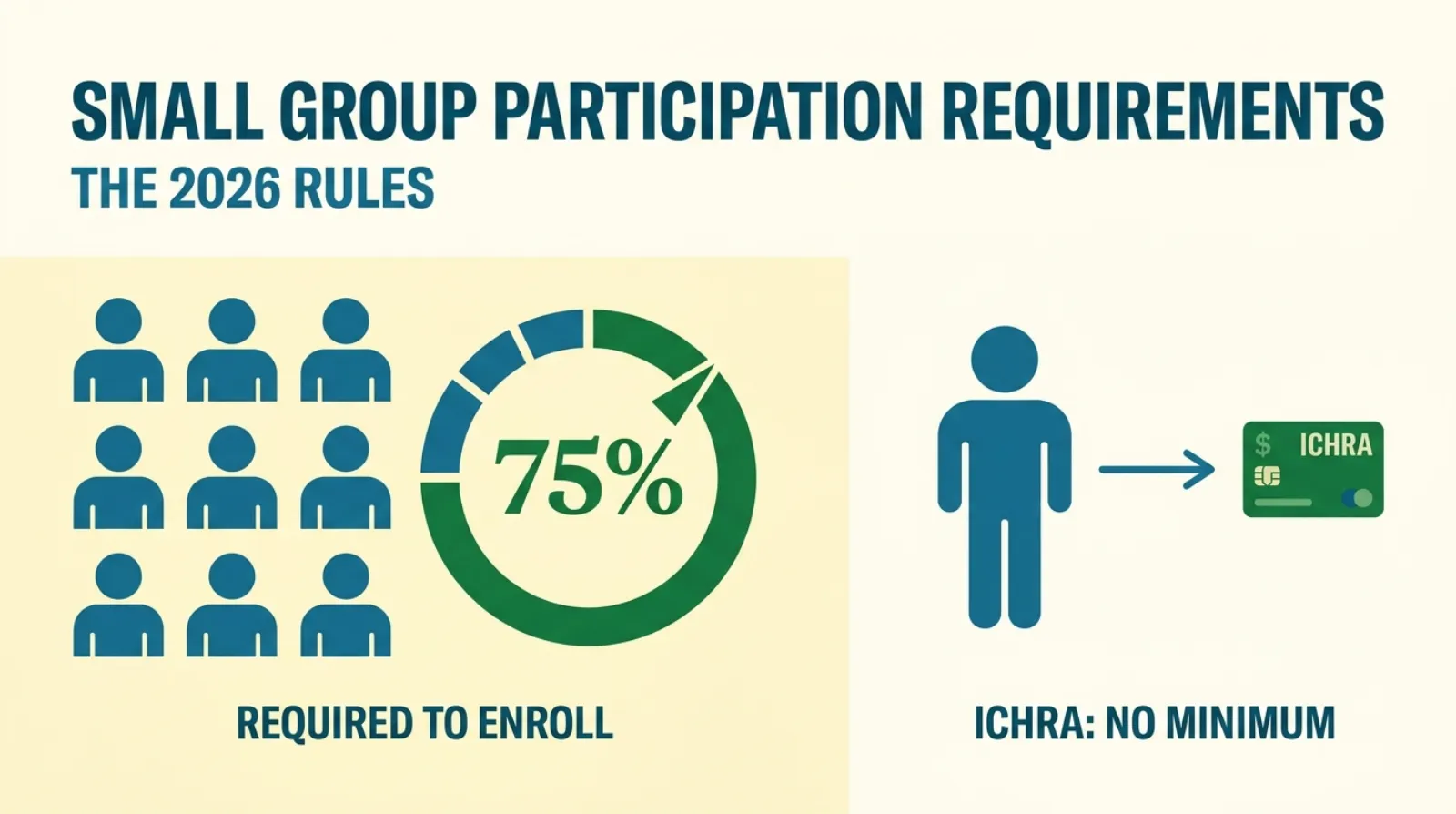
- The common ceiling, drawn from the NAIC model act described in a 2000 federal HHS bulletin, is 100% of eligible employees for groups of three or fewer and 75% for groups of four or more — but the exact number and how it is calculated vary by state and carrier.
- Whether employees who decline because of a spouse's plan count against you depends entirely on how your specific carrier defines the denominator. Ask before you assume.
- An Individual Coverage HRA (ICHRA) has no carrier-side participation percentage to clear. Per HealthCare.gov, it can go to a single eligible employee.
- All figures here are national and regulatory; whether an ICHRA actually costs less than your county's small-group renewal is a separate, county-specific question.
The quick answer
Yes. A small-group health insurance carrier can require a minimum percentage of your eligible employees to enroll before it will issue or renew your group's coverage, and it can decline coverage if that percentage is not met, even when every employee who wants to enroll is allowed to. This is a group participation requirement, and it is a completely separate gate from your renewal rate. You can have a competitive quote and still lose the coverage if enough of your team opted out. An Individual Coverage HRA (ICHRA) does not use this kind of pooled underwriting, so it has no equivalent enrollment percentage to clear.
The rest of this page is the mechanics: where the rule comes from, how carriers actually calculate the percentage, what it costs when a group fails it, and where ICHRA fits once participation stops being the constraint.
The rule
Carriers can require a set share of eligible employees to enroll before issuing small-group coverage, under a federal exception dating to HIPAA.
The trap
How the carrier counts the denominator, whether employees with other coverage are excluded, decides whether the same office of nine people passes or fails.
The alternative
ICHRA reimburses employees individually rather than underwriting a pool, so there is no participation percentage to hit in the first place.
Why a renewal gets denied when nothing else changed
Here is the scenario, and if you run a small business you have probably lived some version of it. You went through open enrollment. Your rates came back reasonable. You did everything a good employer is supposed to do, and then your broker calls with the actual bad news: not enough of your team enrolled, so the carrier will not issue the group policy this year. Nobody did anything wrong. The plan was fine. The problem is a number, not a decision, and the number has nothing to do with premiums.
This tends to hit certain kinds of small teams hardest: an office where half the staff is covered under a spouse's plan, a company with several employees who are on Medicare or a parent's plan, or a team where a handful of people simply decided the employee contribution was not worth it this year. None of that is a red flag about your business. It is exactly the kind of workforce composition a group participation requirement was built to screen out, whether or not that screening makes sense for your specific team.
The requirement is legal, and it is common. It is also the single least understood piece of small-group underwriting among the employers we talk to, because it almost never comes up until the moment it costs someone their coverage. If you are still deciding between an ICHRA and renewing group coverage in general, our ICHRA vs small group decision guide covers that broader comparison; this page is about one specific mechanism inside that decision that most explainers skip.
What a group participation requirement actually is
A group participation requirement, sometimes written as a group participation rule, is a minimum enrollment threshold a small-group carrier sets for a given employer's eligible workforce. Meet it, and the carrier has to issue or renew coverage under federal guaranteed-availability rules. Miss it, and the carrier can decline.
The legal foundation is older than most people expect. Section 2711(a)(1) of the Public Health Service (PHS) Act, added by Title I of the Health Insurance Portability and Accountability Act of 1996 (HIPAA), requires every carrier that sells small-group coverage to accept every small employer that applies, a rule called guaranteed availability. But Section 2711(e) of the same statute carves out an exception: carriers may still apply "group participation rules," which the statute defines as "a requirement relating to the minimum number of participants or beneficiaries that must be enrolled in relation to a specified percentage or number of eligible individuals or employees of an employer." That exact language, and the framework this article builds on, comes from a Health Care Financing Administration (HCFA, the predecessor agency to CMS) bulletin, Program Memorandum Transmittal No. 00-05, issued in November 2000 to insurance commissioners and issuers nationwide.
A few terms worth pinning down, since carriers and brokers use them loosely. A small employer, under the same federal definition, is a business that employed an average of 2 to 50 employees on business days during the prior calendar year, counting part-time employees under the ERISA definition of "employee." An eligible individual is anyone the plan's terms, the issuer's rules, and state law say can enroll, which typically includes employees, their dependents, and sometimes the business owner. The numerator in a participation calculation is the number of people who actually enroll; the denominator is however many "eligible individuals" the carrier decides to count, and as the next two sections show, that second number is where most of the real dispute lives.
One protection is worth knowing before anything else: the 2000 HHS bulletin is explicit that a carrier cannot use a flat headcount minimum, such as "at least 10 employees must enroll," if that minimum would make it impossible for a smaller employer to ever qualify. Only a percentage-based or otherwise achievable rule is valid. If a carrier's stated requirement would exclude your business no matter how many of your employees enrolled, that specific rule is not one they are allowed to enforce under federal law.
What percentage actually has to enroll
There is no single federal number, because Section 2711(e) authorizes states and carriers to set their own participation thresholds within a boundary, not one fixed nationwide percentage. What the 2000 HHS bulletin does document is the percentage most states actually landed on, because most state laws are modeled on the same source: the National Association of Insurance Commissioners' (NAIC) Small Employer and Individual Health Insurance Availability Model Act.
| Group size | Maximum participation a carrier may require |
|---|---|
| 1 to 3 eligible employees | Up to 100% of eligible employees |
| 4 or more eligible employees | Commonly up to 75% of eligible employees |
Source: NAIC Small Employer and Individual Health Insurance Availability Model Act, as summarized in CMS/HCFA Program Memorandum Transmittal No. 00-05 (November 2000). This is a model framework many, not all, states have adopted; it is not annual or plan-year data and does not expire on a schedule the way premium figures do.
The bulletin puts it plainly: "it is common for State laws that address participation requirements to specify that an issuer's rule cannot require the participation of more than a specified percentage (frequently 75 percent)" of eligible employees, for groups above the smallest size tier. Some states go further and are more protective than the model act requires, prohibiting carriers from counting employees who already have other coverage in the denominator at all. Others allow carriers to include those employees, which makes the same real-world enrollment pattern harder to satisfy. Because this varies state by state and carrier by carrier, the only way to know your actual number is to ask your broker or carrier directly, or check with your state Department of Insurance, before you assume 75% is your target.
Why the "impossible" rule matters more than the percentage
The 2000 HHS bulletin's central holding is not really about the number 75. It is that guaranteed availability takes precedence over any participation rule that would make coverage impossible for a small employer to obtain, even if every eligible person who wants to enroll does. A rule requiring at least 10 enrollees regardless of company size, for instance, was specifically called out as invalid, because it would permanently exclude every employer with fewer than 10 eligible employees. A percentage-based rule, like 75% of eligible employees, is valid because a small enough group can always meet it in principle, even if in practice many groups do not.
How the percentage gets calculated: the denominator fight
This is the part that actually determines whether a specific small business passes or fails, and it rarely gets explained clearly before it matters. The same enrollment outcome can pass or fail depending entirely on which employees the carrier counts in the denominator.
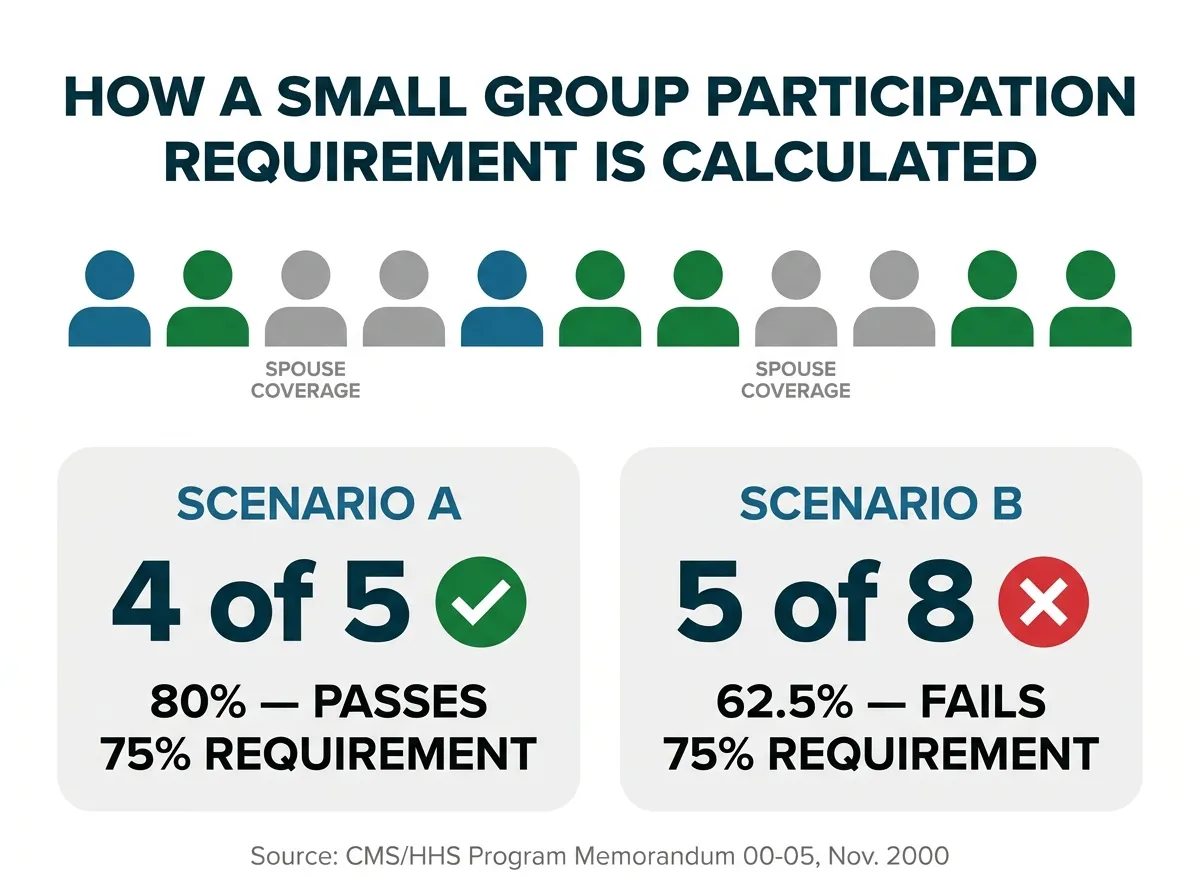
Take a nine-person landscaping company as an example, structured the same way the 2000 HHS bulletin itself walks through the calculation, with different numbers. Say the owner and eight employees are all eligible to enroll. Three of those eight already have coverage through a spouse's employer plan and decline the company's group plan for that reason. Five employees have no other coverage; four of them enroll, and one does not. The carrier's rule requires 75% participation.
| Scenario | Denominator | Numerator | Result |
|---|---|---|---|
| Scenario A: carrier excludes employees who declined coverage due to other insurance | 5 (8 total minus 3 with spousal coverage) | 4 enrolled | 80% — passes a 75% requirement |
| Scenario B: carrier counts every eligible employee in the denominator | 8 (all eligible employees) | 5 enrolled (the maximum possible, since 3 already declined) | 62.5% — fails a 75% requirement |
Illustrative worked example, structured to mirror the calculation method described in CMS/HCFA Program Memorandum Transmittal No. 00-05 (November 2000). Not a quote or a projection for any specific business; actual denominator treatment depends on your carrier and state.
Nothing changed about who wanted coverage between Scenario A and Scenario B. The only variable is whether the carrier's rule excludes people who already have other coverage from the count. That single administrative choice, buried in the carrier's underwriting guidelines rather than your renewal letter, is often the actual reason a business either keeps its group plan or loses it.
What it costs when the math does not work
Losing group eligibility over a participation shortfall does not just mean paperwork. It usually means an employer ends up back on the open market shopping for coverage under worse conditions than the renewal they just lost, at a moment when small-group costs are already climbing on their own. According to KFF's 2025 Employer Health Benefits Survey, the average annual family premium for employer-sponsored coverage nationally reached $26,993 in 2025, up 6%, or $1,408, from the year before. Workers themselves contributed an average of $6,850 of that toward their family premium out of their own paychecks, with employers covering the rest.
Small firms are not cushioned from this. The same KFF survey found that covered workers at firms with fewer than 200 employees face an average deductible of $2,631, well above the $1,670 average at larger firms, and that 53% of covered workers at small firms now face a deductible of at least $2,000. A company that loses its group eligibility over a participation shortfall is not just facing an administrative headache; it is very likely walking back into a market where the next option costs more out of pocket than the coverage it just lost.
That backdrop is showing up in how small-business owners themselves describe the next few years. In an August 2025 survey of 503 owners and managers of small to mid-sized businesses (500 employees or fewer), fielded in July 2025 with a margin of error of about 4 points, eHealth found that 89% of businesses currently sponsoring a group health plan worry they will not be able to afford it within three years, and 93% said it is time for a new health benefit solution because the current model is not working. The same survey found 54% of respondents remain unfamiliar with or uneducated about ICHRA, which tells you the awareness gap is at least as large as the affordability worry.
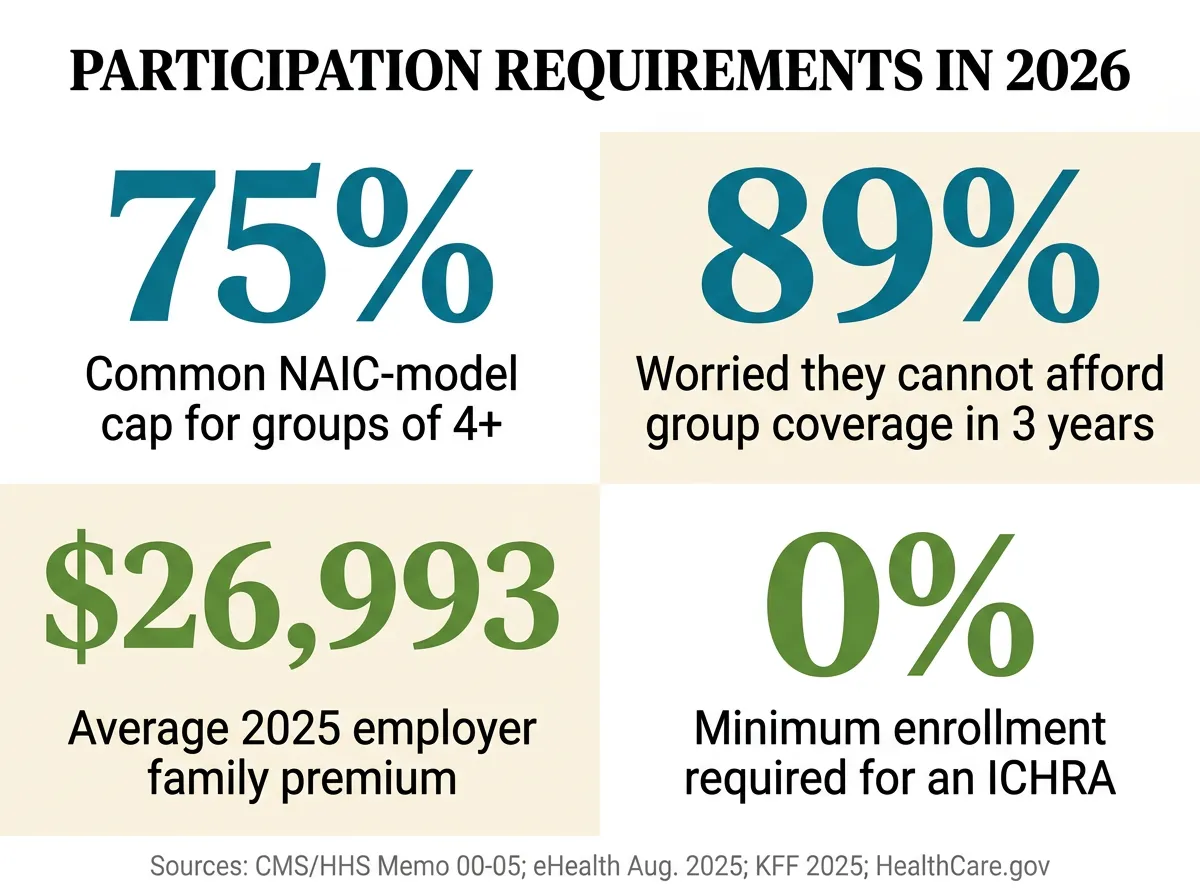
75%
Common NAIC-model participation cap for groups of 4+ eligible employees
89%
Small/mid-sized employers worried they can't afford group coverage in 3 years, 2025
$26,993
Average 2025 employer family premium, up 6% year over year
0
Minimum enrollment percentage required to offer an ICHRA
Sources: CMS/HCFA Program Memorandum Transmittal No. 00-05 (Nov. 2000), NAIC model act figure; eHealth, "Nine in 10 Small to Mid-Sized Businesses Worry They Won't Be Able to Afford Health Benefits in Three Years" (Aug. 20, 2025), national survey; KFF, 2025 Employer Health Benefits Survey (Oct. 22, 2025), national; HealthCare.gov, Individual Coverage HRA page, current as of this article's publish date.
Does an ICHRA have a participation requirement?
No, and this is the structural reason, not just a nicer rule. A small-group plan is a pooled insurance product: the carrier underwrites the whole group together, spreads risk across everyone enrolled, and needs a minimum share of the eligible population in the pool to keep that pricing viable. That is exactly the business logic Section 2711(e) exists to protect. An Individual Coverage HRA is not that. Each employee's ICHRA allowance funds that one person's own individual-market plan, purchased on the ACA marketplace or off it. There is no shared risk pool for the employer's contribution to destabilize, so there is nothing for a carrier-style participation percentage to protect.
Per HealthCare.gov, an employer "can offer an individual coverage Health Reimbursement Arrangement to any eligible employee, or you can offer it only to certain types of your employees." That is the entire enrollment requirement: none. A single employee, on a team of any size, is enough.
There is exactly one situation where a size threshold appears at all, and it has nothing to do with participation. If an employer offers a traditional group health plan to one class of employees and an ICHRA to a different class in the same plan year, a minimum class size applies to keep the two options from being used to sort people by expected health costs, a different concern than the one small-group participation rules address. HealthCare.gov notes that class-size minimum is commonly 10 employees for an employer with under 100 total employees, scaling up for larger employers. If you are not offering a traditional group plan to any class, that rule does not apply to you, and there is no size threshold at all.
What this actually fixes
A team where four of nine people already have coverage through a spouse's plan is a participation nightmare for a small-group carrier and a complete non-issue for an ICHRA. Every employee who wants a contribution gets one; the employees who already have coverage elsewhere simply do not need it. Nobody's decision to decline hurts anyone else's eligibility.
Small group versus ICHRA, side by side
| Dimension | Traditional small group | ICHRA |
|---|---|---|
| Minimum enrollment to offer coverage | Commonly up to 75% of eligible employees (4+ group), up to 100% (1 to 3) | None; a single eligible employee is enough |
| Effect of employees declining for other coverage | Can reduce or increase your pass rate depending on how the carrier defines the denominator | No effect; each employee's allowance is independent |
| Underwriting basis | Pooled group risk, priced as one policy | Individual allowance per employee, no group underwriting |
| Risk of losing the whole offering over enrollment | Real; a shortfall can mean the carrier declines to issue or renew | Not applicable; there is no group policy to decline |
| Minimum class size, if also offering a group plan to another class | Not applicable | Commonly 10 employees for employers under 100 total, only if mixing with a group plan |
Source: CMS/HCFA Program Memorandum Transmittal No. 00-05 (Nov. 2000) for small-group participation mechanics; HealthCare.gov, Individual Coverage HRA page, for ICHRA rules.
How to check whether your group is at risk
Before your next renewal, this takes about fifteen minutes and does not require calling anyone yet.
- Count every eligible employee, not just the ones you expect to enroll. Include part-time staff who meet your plan's eligibility terms; the ERISA definition of "employee" underlying this rule includes them.
- List who already has other coverage, and why. A spouse's employer plan, Medicare, Medicaid, or a parent's plan are the most common reasons employees decline.
- Ask your carrier or broker, in writing, exactly what your participation requirement is and how the denominator is calculated. Do not assume 75%; do not assume employees with other coverage are excluded. Get the specific answer for your specific policy.
- Run both denominator scenarios against your actual headcount, the way the table above does, before open enrollment closes, not after.
- If the math is close or fails, decide early whether an ICHRA removes the constraint entirely for your workforce, rather than finding out from a declined renewal.
A worked example: Jefferson County, Kentucky
Say the landscaping company from the earlier example is based in Jefferson County, Kentucky, home to Louisville and a population of 779,232 in our dataset. Its small-group renewal just got declined over the participation shortfall in Scenario B above. The owner wants to know what an ICHRA would actually cost for the same 8 eligible employees, participation math aside.
Per src/data/qualified_counties.json, Jefferson County's 2026 individual-market
benchmark premium runs an estimated $370 a month, against a
small-group benchmark of $522 a month for the same county, a spread of
an estimated 29.0%, or $1,817 a year
per employee. See the rest of Kentucky's qualifying counties on our
Kentucky savings page.
Jefferson County, Kentucky: 2026 benchmark premiums
Individual-market vs. small-group benchmark, monthly, per employee
Source: src/data/qualified_counties.json, 2026 plan year (Ideon rate data,
cross-verified against CMS public-use marketplace files). Estimates, not quotes.
Example: funding all 8 eligible employees at the county benchmark, participation aside
Funding each of the 8 eligible employees at Jefferson County's individual-market benchmark of $370 a month costs 8 × $370 × 12 months = $35,539 a year, versus the small-group benchmark of $522 a month, or $50,074 a year for a policy the carrier might not have issued at all under Scenario B. Every one of the 8 employees can receive a contribution under the ICHRA, including the three who declined group coverage because of a spouse's plan, since their eligibility for the ICHRA does not depend on whether they use it. This is an illustrative comparison, not a projection for any specific business; actual results depend on each employee's age, plan choice, and household income, and on the employer's own contribution decision.
Where ICHRA is not automatically the answer
Removing the participation constraint does not automatically mean an ICHRA saves money. It only means the carrier-side enrollment math stops being the reason you can or cannot offer coverage at all; whether the coverage costs less is a separate, purely economic question, decided county by county.
Our dataset currently identifies 719 counties across 18 states, out of more than 3,100 counties nationwide, where the 2026 individual-market benchmark premium runs below the small-group benchmark, by an estimated 20.1% to 62.3%, averaging 32.9% across those counties. That means most US counties are not on this list. Mike Moore is based in Sioux Falls, South Dakota, and Minnehaha County, South Dakota does not currently appear among the 719 qualifying counties in this dataset either, which is worth saying plainly rather than glossing over: county-level economics, not brand loyalty, decide whether this makes sense anywhere, including here.
| State | Qualifying counties | Avg. estimated savings | Avg. annual savings/employee |
|---|---|---|---|
| Georgia | 130 | 41.8% | $3,281 |
| Kentucky | 104 | 26.5% | $1,765 |
| Virginia | 89 | 22.3% | $1,049 |
| Ohio | 88 | 53.7% | $4,824 |
| Indiana | 75 | 32.6% | $1,910 |
| New York | 47 | 28% | $2,665 |
| South Carolina | 40 | 30.1% | $1,710 |
| Kansas | 35 | 29.1% | $1,873 |
Source: src/data/qualified_counties.json, 2026 plan year (Ideon rate data,
cross-verified against CMS public-use marketplace files). 719 qualifying
counties across 18 states total; not every state appears in this table.
Savings estimates only, not a quote or a guarantee.
A team spread across several states makes this more, not less, worth checking, since a participation shortfall that would have killed a single multi-state group policy has no bearing on an ICHRA at all: employees in a qualifying county and employees in a non-qualifying county can both receive the same class-based contribution, and each one's plan choice reflects their own local market.
Where employers get this wrong
What sinks a group renewal without warning
- Assuming 75% is a fixed number, when it is only a common ceiling, not a floor everyone shares
- Never asking whether employees with other coverage are excluded from the denominator until the renewal is already declined
- Waiting until open enrollment closes to count actual eligible headcount against expected enrollment
- Treating a participation shortfall as a rate problem and trying to fix it by shopping carriers, when it is an enrollment-mix problem
What a clean check looks like
- Get your carrier's exact percentage and denominator method in writing before renewal season
- Run the numerator/denominator math against your real headcount weeks, not days, before the deadline
- Model an ICHRA in parallel for any team where the participation math looks close
- Check the county-level savings math separately, since it does not depend on the participation question at all
Most employers who lose group coverage over a participation shortfall never learn the actual mechanism. They just get told the carrier declined the renewal, and they assume it was about the rates.
Mike MooreHow ICHRA Savings fits in
We do not sell small-group insurance, and we are not the ones setting your carrier's participation rule. What we built is the county-level dataset used throughout this article: a comparison of the 2026 individual-market benchmark against the small-group benchmark in every US county, so you can see, before any plan-design conversation, whether an ICHRA is likely to cost less than what you are paying, or would have paid, for group coverage in your specific counties.
If your team's participation math is the actual obstacle, an ICHRA removes that specific constraint regardless of your county's savings number. If you also want to know whether it saves money once that constraint is gone, that is exactly what the map is for.
Check your county before you finalize anything
Before assuming an ICHRA is the answer, check whether your county is one where the underlying numbers work in your favor: Check your county on the savings map →
What this does not guarantee
Read this before you change anything about your current coverage
- This is not tax, legal, or HR advice. Your exact participation requirement and how your carrier calculates it depend on your specific state, carrier, and policy, none of which this article can see.
- The 20% to 62% county savings range applies only in qualifying counties, and only as an estimate for the 2026 plan year. Most US counties are not on this list.
- Taking an ICHRA generally means an employee waives premium tax credit eligibility for any month the offer applies, regardless of the participation question covered here. See our ACA subsidy cliff guide for the income thresholds involved.
- None of the figures in this article are an offer of insurance, a quote, or a guarantee of coverage, savings, or a tax outcome for any specific employer or employee.
- Confirm your carrier's actual participation rule and denominator method directly before making any coverage decision based on the general figures in this article.
How these numbers are calculated
The federal framework and the NAIC model act figures in this article come from CMS/HCFA Program Memorandum Transmittal No. 00-05, a bulletin issued to state insurance commissioners and issuers in November 2000, interpreting Section 2711 of the Public Health Service Act as added by HIPAA in 1996; it remains published on cms.gov and is the framework this article relies on for how group participation rules work and what they can and cannot require. The worked participation-math example is an original illustration built to mirror that bulletin's own numerator/denominator method, using different figures, not a real business. The ICHRA participation and class-size rules come directly from HealthCare.gov's Individual Coverage HRA page, fetched for this article. The premium and affordability figures come from KFF's 2025 Employer Health Benefits Survey and an eHealth survey of small and mid-sized business owners, both cited above with their publish dates. The Jefferson County, Kentucky and state-level figures come from the same dataset that powers our savings map: a 2026 individual-market benchmark premium (the second-lowest-cost silver plan available to a representative enrollee, the same benchmark the federal government uses to calculate premium tax credits) compared against a small-group benchmark premium built from comparable small-group filings for that rating area. Both figures come from Ideon, a licensed insurance rate-data provider, cross-verified against CMS public-use marketplace files before publication.
One limitation worth stating plainly: participation requirements are set at the state and carrier level, not uniformly by the federal government, so the 100%/75% figures in this article are a common example drawn from the NAIC model act, not a guarantee of what your specific carrier requires. Always confirm the exact rule with your broker, carrier, or state Department of Insurance before making a coverage decision.
Questions employers actually ask
What is a group participation requirement in small-group health insurance?
A group participation requirement, sometimes called a group participation rule, is a threshold an insurance carrier sets for how many of a small employer’s eligible employees must enroll in a group health plan before the carrier will issue or renew coverage for that employer. It is authorized under Section 2711(e) of the Public Health Service Act, added by HIPAA in 1996, which lets carriers use participation rules as long as they do not make coverage impossible for an eligible small employer to obtain, per a Health Care Financing Administration (the predecessor to CMS) bulletin, Program Memorandum Transmittal No. 00-05 (November 2000).
What percentage of employees actually has to enroll?
It varies by state and by carrier, since the federal rule sets an outer boundary rather than one fixed number. The NAIC’s Small Employer and Individual Health Insurance Availability Model Act, described in the same 2000 HHS bulletin, caps a carrier’s participation requirement at 100% of eligible employees for groups of three or fewer and 75% for groups of four or more. HHS notes it is common for state laws addressing this to specify a maximum of "frequently 75 percent." Your specific carrier and state may set a different number within that federal boundary, so confirm the exact figure with your broker or state Department of Insurance before assuming 75% applies to you.
Do employees who decline coverage because they have other insurance count against us?
It depends on how the carrier defines the denominator, and this is the detail that decides whether most small groups pass or fail. Under the framework in the HHS bulletin, some plans exclude employees who have declined coverage because they already have other health coverage (through a spouse’s plan, Medicare, or Medicaid) from the participation calculation entirely, which makes the required percentage far easier to hit. Other carriers count every eligible employee in the denominator regardless of existing coverage, which makes the same real-world enrollment pattern fail the same percentage test. Ask your carrier directly which method they use before you count on a specific number of enrollees being enough.
What happens if a small employer does not meet the participation requirement?
The carrier can decline to issue or renew group coverage for that employer, even if every single employee who wants coverage is allowed to enroll. This is not a penalty for doing anything wrong; it is a standard underwriting tool carriers use to keep their risk pool from skewing toward people who expect to use more care, and it is expressly permitted under Section 2711(e) of the Public Health Service Act as long as it does not make coverage impossible for every eligible employee combined.
Does an ICHRA have a participation requirement?
No, not in the way small-group coverage does. Per HealthCare.gov, an employer can offer an Individual Coverage HRA to a single eligible employee, or to whatever class of employees it defines, with no minimum enrollment percentage required to make the arrangement valid. A minimum class size only becomes relevant in one specific circumstance: when an employer offers a traditional group health plan to one class of employees and an ICHRA to a different class in the same plan year. If you are not offering a group plan to anyone, that class-size rule does not apply to you at all.
Can I offer an ICHRA to just one employee?
Yes. HealthCare.gov states plainly that an employer can offer an individual coverage HRA "to any eligible employee, or you can offer it only to certain types of your employees." There is no carrier-side participation percentage to clear, because an ICHRA is not underwritten as a pooled group insurance product the way small-group coverage is; each employee’s reimbursement is a separate arrangement funding their own individual-market plan choice.
Is the small-group participation rule the same in every state?
No. Group participation rules are authorized at the federal level but implemented through state insurance law and individual carrier underwriting guidelines, so the exact percentage, and which employees count in the denominator, varies by state and by carrier. The 100%-for-three-or-fewer and 75%-for-four-or-more figures cited in this article come from the NAIC model act referenced in a 2000 federal bulletin as a common example, not a universal national rule. Confirm your specific state and carrier’s requirement directly.
Where can I check whether an ICHRA actually saves money in my county, separately from the participation question?
The participation-rule mechanics in this article apply nationally and do not depend on where your business is located. Whether an ICHRA costs less than small-group coverage in the first place is a separate, county-specific question, since individual-market and small-group premiums are priced by rating area. Use the savings map to check your specific counties before deciding which arrangement to pursue.
Sources
- CMS/HCFA, Program Memorandum Transmittal No. 00-05, "Guaranteed Availability Under Title XXVII of the Public Health Service Act — Applicability of Group Participation Rules" (Nov. 2000)
- HealthCare.gov, "Individual coverage Health Reimbursement Arrangements", ICHRA eligibility, class, and enrollment rules
- IRS Newsroom, "Health Reimbursement Arrangements (HRAs)", page last reviewed Jan. 15, 2026
- eHealth, "Nine in 10 Small to Mid-Sized Businesses Worry They Won't Be Able to Afford Health Benefits in Three Years" (Aug. 20, 2025)
- KFF, "Annual Family Premiums for Employer Coverage Rise 6% in 2025" (Oct. 22, 2025)
- ICHRA final rule: Departments of the Treasury/IRS, Labor, and Health and Human Services (2019, effective for plan years beginning 2020)
- County-level premium comparison:
src/data/qualified_counties.json, 2026 plan year (Ideon rate data, cross-verified against CMS public-use marketplace files)