Small-Group Premiums Jump 14% in 2027: What to Do
Insurers requested a median 14% small-group rate hike for 2027. See why, the IRS affordability rule, and where ICHRA estimates save more in Kentucky.
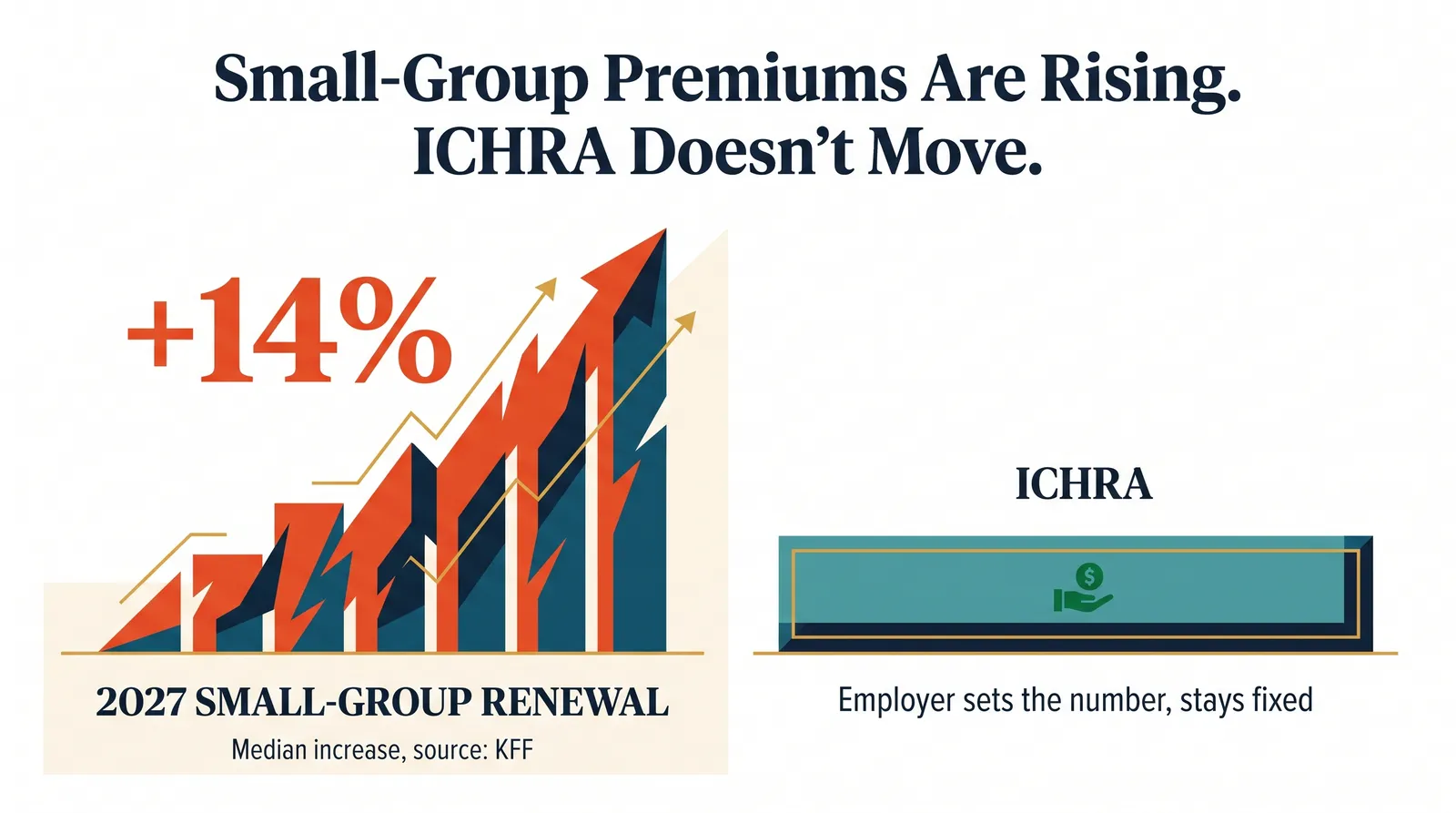
The short version
- Insurers requested a median 14% small-group premium increase for the 2027 plan year, across 295 insurers in all 50 states and D.C., per KFF.
- The main drivers are a 10.8% underlying medical-trend estimate, specialty-drug and GLP-1 costs, fast-growing behavioral-health spending, and a small-group risk pool that has shrunk 41% since 2013 as healthier groups leave.
- The IRS set the 2026 ICHRA/ACA affordability threshold at 9.96% of household income, which is the number that actually decides whether a given ICHRA contribution is enough.
- In Kentucky, 104 of 120 counties show a 2026 individual-market benchmark below small group in our dataset, including Jefferson County (Louisville) at an estimated 29.0%.
- A steep renewal is a reason to check your county's math, not a reason to switch on its own. Not every county favors ICHRA, and this article says exactly where in Kentucky it does not.
Why small-group premiums are jumping for 2027
Insurers filed for a median 14% small-group premium increase for the 2027 plan year, according to the Peterson-KFF Health System Tracker's analysis of preliminary rate filings from 295 insurers across all 50 states and Washington, D.C., published August 6, 2026. Fifty-nine percent of those insurers requested somewhere between 10% and 20%. If your renewal letter lands in that range this cycle, you are not being singled out. You are the median.
That number matters for a specific reason beyond the sticker shock: it is the fourth consecutive year small-group premiums have risen faster than wages for most small employers, and it is happening at the same time the individual market, the one an Individual Coverage HRA (ICHRA) plugs into, is priced completely differently. An ICHRA is an IRS-defined arrangement where the employer sets a fixed monthly contribution and each employee buys their own ACA-compliant individual health plan with it, tax-free. The employer's number does not move because a carrier repriced a group renewal. Whether that fixed number actually beats what your county's small-group market now costs is the real question this article works through, county by county, using real 2026 data rather than a national average.
What is going up
Small-group renewal premiums, a median 14% for 2027, driven mostly by underlying medical cost, not a one-time event.
What is not automatically going up
An ICHRA contribution. The employer sets it and it stays fixed until the employer changes it, regardless of any carrier's renewal cycle.
What decides whether switching helps
Your county's individual-market rate relative to small group. That is a local question, and this article answers it for Kentucky.
The renewal letter headed your way
You budgeted a reasonable bump. Six percent, maybe eight if you were being cautious. Then the letter came in at 14, 17, sometimes higher, and now you have a few weeks to explain a number to your owner or your board that you did not choose and cannot fully justify. That is the actual moment most employers start looking seriously at an ICHRA, and it is the wrong moment to make the decision, because a bad renewal and a good ICHRA county are two separate facts that happen to arrive at the same time.
Here is the part worth sitting with before you do anything else: your renewal number tells you what your current carrier thinks your group will cost next year. It tells you nothing about what the individual market costs in the counties where your employees actually live. Those are different markets, priced by different mechanisms, and conflating them is the most common mistake employers make when they start comparing options under deadline pressure.
What's actually driving the 14%
Insurers do not file for a double-digit increase without a reason, and the Peterson-KFF analysis lays out what they told regulators. The median underlying medical-trend estimate, meaning how much insurers expect the actual cost of care to rise before any margin or administrative cost is added, comes in at 10.8% for 2027. On top of that trend, insurers named a short list of specific cost drivers.
Specialty drugs are described in the filings as having "a material impact on current trends," with a "lack of low cost substitutes," meaning there is often no generic or biosimilar option to switch a patient onto once they start one. GLP-1 medications, the class that includes drugs originally approved for diabetes and now widely used for weight loss, show continuing growth in utilization among diabetes patients specifically. Behavioral health spending "has experienced rapid growth, exceeding 20% annually over the past two years," a pace that outstrips medical trend on its own. Two insurers in the sample also cited the No Surprises Act's independent dispute resolution process as a contributor, with one insurer estimating a 0.8 percentage point effect from that mechanism alone.
There is a second force working underneath all of that: the small-group market itself is shrinking, and it is shrinking in a way that raises prices for whoever is left. Fully-insured small-group enrollment fell 41%, from roughly 17 million people in 2013 to about 10 million in 2024, per the same KFF analysis. Insurers point to healthier, younger groups moving to self-funded or level-funded arrangements, which pulls better risk out of the fully-insured pool and leaves a smaller, costlier group behind to absorb the trend. If your business has stayed on a traditional fully-insured small-group plan while other employers around you have moved to level funding or dropped coverage altogether, you are, in effect, subsidizing part of that shift.
This is not a one-year spike
A 10.8% underlying medical-trend estimate is a statement about the ongoing cost of care, not a single bad year working its way through the system. Absent a structural change to how your group is covered, next year's renewal conversation is likely to sound a lot like this one.
What a 14% renewal costs, worked out
Numbers land differently once they are attached to a real headcount. Take a 12-person small business paying an illustrative $650 a month per employee for small-group coverage today, a plausible figure for a modest plan in many markets. A 14% increase adds $91 a month per employee, or $1,092 a year per employee. Across 12 employees, that is an extra $13,104 a year, with no change in coverage, no new benefit, nothing different for the employee at all. That is the cost of standing still.
Illustrative math: a 12-person renewal at the national median increase
$650/month per employee × 14% = $91 /month more per employee × 12 months × 12 employees = $13,104 more a year, just to keep the same plan. This is an illustrative example using a round starting premium, not a quote or a projection for any specific business. Your own starting premium and your own renewal percentage will differ.
This is the number employers actually feel, and it is also the number that gets people asking about ICHRA for the wrong reason: to escape a bad renewal, rather than because the math for their county favors it. Both can be true for the same employer. Neither one proves the other.
The IRS rule that decides whether ICHRA works
Before comparing dollar figures, it helps to define a few terms, because the rule that actually governs an ICHRA contribution has nothing to do with your old renewal number.
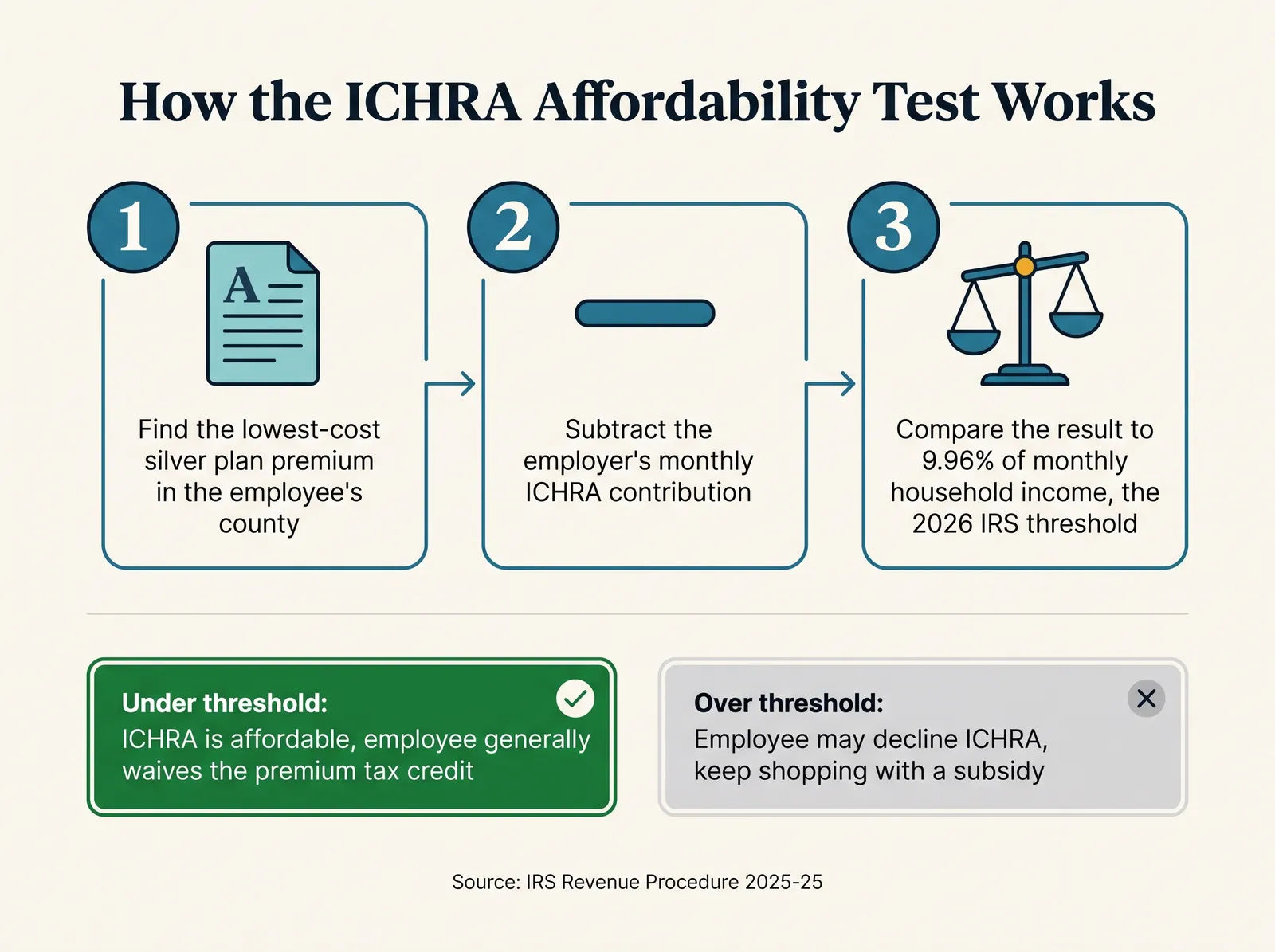
The premium tax credit is the ACA subsidy that reduces what an eligible person pays for an individual-market plan bought through the marketplace. Affordability, in this context, is an IRS test that decides whether an employer's coverage offer is cheap enough, relative to the employee's income, that the employee is expected to use it instead of claiming that subsidy. For the 2026 plan year, the IRS set the required contribution percentage at 9.96% of household income, under Revenue Procedure 2025-25. In practice, that means an employee's monthly cost for the lowest-cost silver plan (LCSP) available in their rating area, after subtracting the employer's ICHRA contribution, cannot exceed 9.96% of that employee's household income for the ICHRA to count as affordable.
Employers do not have to know each employee's exact household income to apply this test. The IRS permits safe harbors, simplified stand-ins for income, including one based on the employee's W-2 wages, one based on their rate of pay, and one based on the federal poverty line, that let an employer run the math without asking anyone for their tax return. Which safe harbor fits depends on your workforce and is worth working through with a benefits attorney or a qualified administrator rather than guessing.
Why this matters here: if the ICHRA is affordable for an employee under this test, that employee generally has to waive the premium tax credit to use it. If it is not affordable, the employee can decline the ICHRA and shop the marketplace with a subsidy instead. Set your contribution too low relative to local individual-market rates, and you can end up offering a benefit some employees are financially better off declining. That is a design problem, not a reason to avoid ICHRA altogether, and it is exactly why the county-level rate data below matters more than the national renewal headline.
Where ICHRA already beats it: Kentucky, 2026
Kentucky has 120 counties, more than every state except Texas, Georgia, and Virginia. In our 2026 dataset, 104 of them show an individual-market benchmark premium below the small-group benchmark, which is where an ICHRA has room to cost less than what a small-group renewal, 14% increase or not, would charge for the same coverage.
| Figure | Value | Geography | Source |
|---|---|---|---|
| Median proposed small-group premium increase, plan year 2027 | 14% | National | KFF / Peterson-KFF Health System Tracker |
| Share of insurers requesting a 10% to 20% increase, plan year 2027 | 59% | National | KFF / Peterson-KFF Health System Tracker |
| Median underlying medical-trend estimate cited by insurers, plan year 2027 | 10.8% | National | KFF / Peterson-KFF Health System Tracker |
| Decline in fully-insured small-group enrollment, 2013 to 2024 | 41% | National | KFF / Peterson-KFF Health System Tracker |
| ACA/ICHRA affordability contribution percentage, plan year 2026 | 9.96% | Federal | IRS Revenue Procedure 2025-25 |
| Estimated ICHRA savings vs. small group, Jefferson County, KY | 29.0% ($1,817/yr per employee) | Jefferson County, KY | qualified_counties.json |
National figures: KFF / Peterson-KFF Health System Tracker, "How Much and Why Premiums Are
Going Up for Small Businesses in 2027," Aug. 6, 2026 (analysis of preliminary 2027 rate
filings from 295 insurers, all 50 states and D.C.). Affordability figure: IRS Revenue
Procedure 2025-25. County figures: src/data/qualified_counties.json, 2026 plan
year.
Table 2 shows Kentucky's eight most populous qualifying counties directly from that dataset, not a hand-built example. Every county listed shows the second-lowest-cost silver plan in that rating area, the individual-market benchmark, running below the small-group benchmark for 2026.
| County | Population | Individual benchmark | Small-group benchmark | Est. savings |
|---|---|---|---|---|
| Jefferson County | 779,232 | $370/mo | $522/mo | 29.0% |
| Fayette County | 321,276 | $369/mo | $516/mo | 28.6% |
| Kenton County | 169,066 | $407/mo | $622/mo | 34.5% |
| Boone County | 136,150 | $407/mo | $622/mo | 34.5% |
| Warren County | 135,307 | $412/mo | $529/mo | 22.1% |
| Hardin County | 111,005 | $370/mo | $522/mo | 29.0% |
| Daviess County | 102,916 | $442/mo | $577/mo | 23.3% |
| Campbell County | 93,122 | $407/mo | $622/mo | 34.5% |
Source: src/data/qualified_counties.json, 2026 plan year (Ideon rate data,
cross-verified against CMS public-use marketplace files). Estimates, not quotes. Individual
results vary by age, plan selection, and carrier participation.
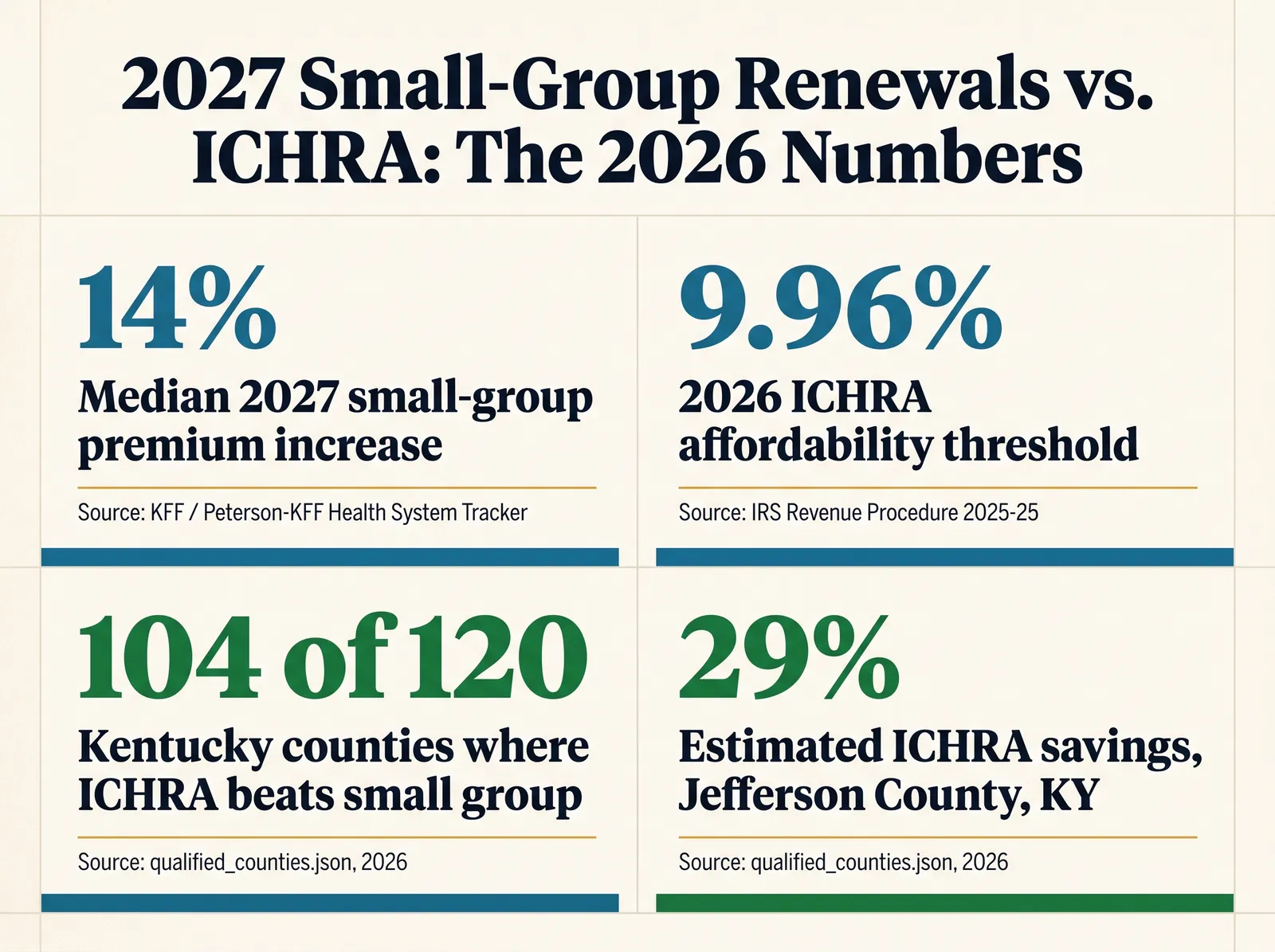
Jefferson County, home to Louisville and Kentucky's most populous county at 779,232 people in this dataset, shows a 2026 individual-market benchmark of $370 a month against a small-group benchmark of $522 a month, an estimated 29.0% spread, or $1,817 a year per employee. See every qualifying Kentucky county on our Kentucky savings page.
Jefferson County, Kentucky: 2026 benchmark premiums
Individual-market vs. small-group benchmark, monthly, per employee
Source: src/data/qualified_counties.json, 2026 plan year (Ideon rate data,
cross-verified against CMS public-use marketplace files). Estimates, not quotes.
Example: a 12-person Jefferson County employer facing a 2027 renewal
Funding each employee at the county's individual-market benchmark of $370 a month through an ICHRA costs 12 × $370 × 12 months = $53,309 a year, a number the employer chose and that does not move at the next renewal cycle. Staying on a small-group plan priced at this county's $522 a month benchmark, before any 2027 increase is even applied, runs $75,110 a year. The gap is an estimated $21,802 a year across the group, before this cycle's renewal increase makes the small-group side larger still. This is an illustrative comparison built from the county dataset, not a projection for any specific business.
Where small group is still the better call
It would be easy to end the article here and call it settled. It would also be dishonest, because the same dataset that shows 104 winning Kentucky counties shows real variation among them, and shows plenty of counties nationally where small group still wins outright.
Inside Kentucky itself, the size of the win moves around a lot. Warren County, home to Bowling Green and the state's fifth most populous qualifying county at 135,307 people, shows a 22.1% estimated spread, an individual-market benchmark of $412 a month against a small-group benchmark of $529, meaningfully narrower than Jefferson County's gap. An ICHRA can still be the right call there, but the margin for error in setting the contribution is smaller, and it is worth running the specific county rather than assuming every part of the state performs like Louisville.
Nationally, the picture is starker. Our dataset shows entire states, Florida among them, where zero counties currently qualify because individual-market rates run above small-group rates statewide. If your workforce sits mostly in a state or county like that, a 14% small-group increase is a real problem, but an ICHRA is not the fix for it; a level-funded plan, a different small-group carrier, or plan-design changes are more likely to help. Saying this plainly costs us nothing and it is the reason we built a county map instead of a single national pitch.
A bad renewal is not proof ICHRA will help you
The size of your 2027 increase and the size of your county's ICHRA savings are two unrelated numbers. Check both before you decide anything.
What actually changes for your employees
Employers weighing this decision tend to run the arithmetic first and think about the people side second. It is worth reversing that order for a minute, because what changes for an employee is not the same as what changes for the business, and getting it wrong is where rollouts run into trouble that no spreadsheet predicts.
Under small-group coverage, the employer picks the plan, usually one or two options, and every employee gets the same network whether it fits their doctor, their kid's specialist, or not. Under an ICHRA, the employee shops the individual market directly and picks whatever ACA-compliant plan fits them, which for most people is the first time they have ever done that. Some employees find this liberating. Others find it stressful, especially in the first enrollment window, because nobody handed them a plan; they have to choose one. That is not a reason to avoid ICHRA. It is a reason to budget for real onboarding help, not just a benefits email with a link in it.
There is also a subsidy conversation every employer needs to have honestly with their team. An employee who was previously buying an unsubsidized individual plan, or who has a spouse's employer offering coverage, may come out ahead under an ICHRA. An employee who was receiving a significant premium tax credit and whose ICHRA is deemed affordable under the IRS test will generally have to give that credit up for the months the ICHRA applies. For some households that is a wash; for others it is a real change in take-home cost, and finding out at enrollment rather than beforehand is how trust in the whole rollout gets damaged. Walk your team through the trade-off before the notice goes out, not after.
How to work the decision, in order
- Get your renewal in writing. You need the actual percentage and the actual per-employee premium, not a verbal estimate, to compare against anything.
- Pull your census by county. Not by headquarters, by where employees actually live, since the individual-market benchmark varies by county.
- Check your specific counties on the savings map. A statewide or national figure will hide the counties where this does not work for you.
- Model affordability before setting a contribution amount. Use the 9.96% threshold and a safe harbor that fits your workforce, not a round number.
- Compare the full annual cost, not just the monthly headline. Include what your 2027 small-group renewal would actually run for the year against the ICHRA contribution total.
- Tell your employees what changes for them, including the subsidy trade-off, before the notice goes out. A rollout that surprises people at enrollment loses their trust before it saves anyone money.
- Budget for the notice and onboarding timeline. ICHRA requires advance employee notice before the new plan year begins, and employees new to shopping the individual market need guidance once, at the start.
Run the county check before the renewal deadline pressure sets in
Ten minutes on the savings map tells you whether the rest of this process is worth starting, before you are negotiating against a signature deadline. Check your county on the savings map →
Your renewal letter tells you what your carrier thinks your group will cost. It does not tell you what the individual market costs where your employees live. Those are two different questions, and only one of them is on the letter.
Mike MooreChecking your own counties
Everything above about why premiums are rising nationally is market-wide context; it applies the same way no matter where your team sits. Whether an ICHRA actually costs less than a 2027 small-group renewal is not market-wide. It depends on the individual-market and small-group benchmark premiums in each county your employees live in, which is exactly what our county dataset and savings map are built to show, for the 2026 plan year.
If your renewal is already in hand and you are working against a deadline, it is worth a conversation: talk to an advisor about your timeline → If you would rather look at the mechanics yourself first, start with how ICHRA works.
What this does not guarantee
Read this before you compare quotes
- This is not tax, legal, or HR advice. Whether an ICHRA is right for your business depends on facts this article cannot see.
- The 14% figure is a national median from preliminary filings, not your renewal. Your actual increase can land above or below it.
- Taking an ICHRA generally means an employee waives premium tax credit eligibility for any month the offer applies, regardless of the county math. See our ACA subsidy cliff guide for the income thresholds involved.
- None of the figures in this article are an offer of insurance, a quote, or a guarantee of savings or tax outcome for any specific employer or employee.
- ICHRA Savings is a private, independent advisory service and is not connected with or endorsed by the U.S. government, HealthCare.gov, the IRS, or CMS.
How these numbers are calculated
The national premium figures come from the Peterson-KFF Health System Tracker's analysis of preliminary 2027 rate filings from 295 insurers across all 50 states and D.C., published August 6, 2026, which found a median proposed increase of 14% for ACA-compliant small-group plans, with 59% of insurers requesting between 10% and 20%. That analysis is currently the only source we found reporting this specific national figure at this level of detail; we are saying so directly rather than implying a second independent confirmation that does not exist. The IRS affordability percentage comes directly from Revenue Procedure 2025-25. The Kentucky county figures come from the same dataset that powers our savings map: a 2026 individual-market benchmark premium, the second-lowest-cost silver plan available to a representative enrollee, compared against a small-group benchmark premium built from comparable small-group filings for that rating area. Both figures come from Ideon, a licensed insurance rate-data provider, cross-verified against CMS public-use marketplace files before publication. The 120-county total for Kentucky is confirmed by the Kentucky Department of Insurance.
One limitation worth stating plainly: the illustrative renewal math in this article uses a round starting premium, not a real employer's bill, because there is no single "average" small- group premium that applies to every business. Use this article to understand the mechanism and the direction of the market, then run your own renewal and your own counties before deciding anything.
Questions employers actually ask
Why are small-group health insurance premiums going up so much for 2027?
Is the 14% increase the same in every state?
What is the IRS affordability threshold and why does it matter for ICHRA?
Does moving to an ICHRA mean employees lose their premium tax credit?
Does ICHRA save money everywhere in Kentucky?
Is a 14% renewal, by itself, a reason to switch to an ICHRA?
What's the difference between the individual-market benchmark and my current small-group premium?
Where can I check what an ICHRA would actually cost for my team?
Sources
- KFF / Peterson-KFF Health System Tracker, "How Much and Why Premiums Are Going Up for Small Businesses in 2027" (Aug. 6, 2026)
- IRS, Revenue Procedure 2025-25 (2026 ACA affordability contribution percentage)
- HealthCare.gov, "Individual coverage Health Reimbursement Arrangements"
- HRA Council, Volume 4 ICHRA & QSEHRA growth report (June 17, 2025; 2024-2025 data)
- Kentucky county count (120): Kentucky Department of Insurance
- ICHRA final rule: Departments of the Treasury/IRS, Labor, and Health and Human Services (2020)
- County-level premium comparison:
src/data/qualified_counties.json, 2026 plan year (Ideon rate data, cross-verified against CMS public-use marketplace files)